



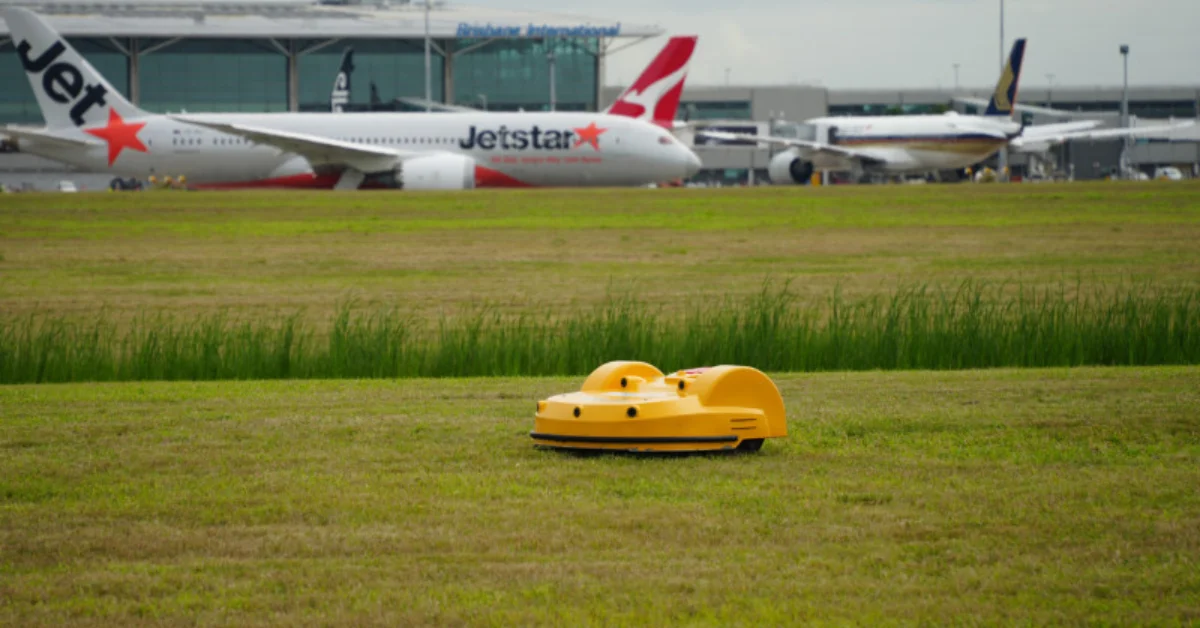
Brisbane Airport robot mowers are taking on grass maintenance across airside land, with four autonomous machines being trialled to reduce diesel use, support safe operations and manage large grassed areas more efficiently.
Brisbane Airport Robot Mowers Take On Airside Grass
Across Brisbane Airport’s airside land, a small fleet of autonomous robot mowers is being trialled as part of a new approach to maintaining grassed areas around airport operations.


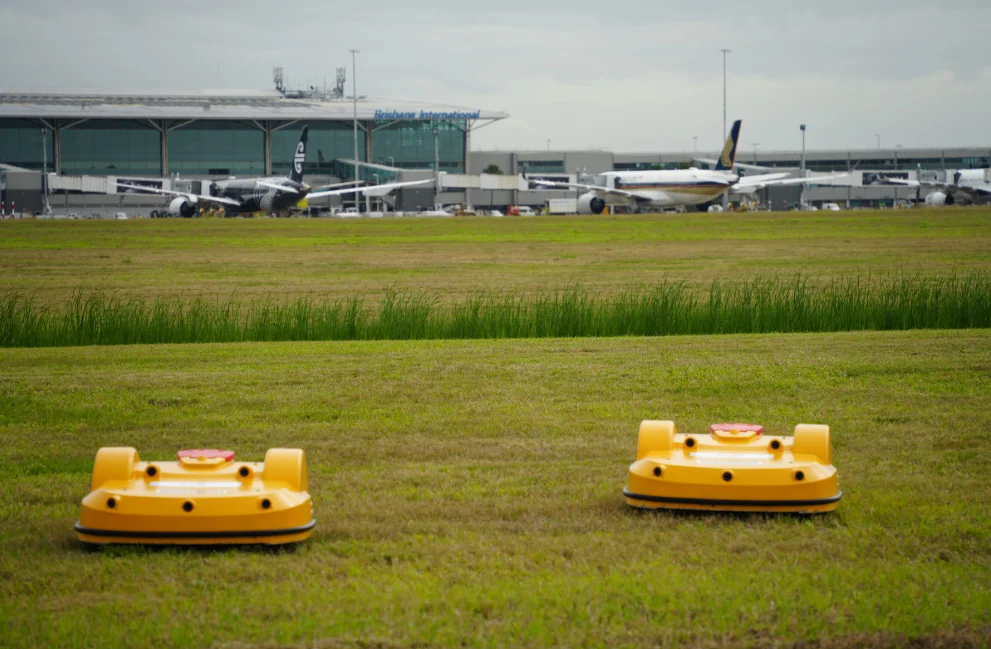
Brisbane Airport has become Australia’s first major airport to trial the rollout of autonomous robot mowers. Four machines are operating within prescribed safe areas, using sensors, geofencing, real-time monitoring and a physical barrier to keep them inside approved zones.
The pilot program is managing a growing portion of the airport’s 919 hectares of airside land, an area described as equivalent to 54 South Bank Parklands.

Coverage is expected to extend into additional airside areas over time as the fleet grows.

A Continuous Cut Around Controlled Areas
The mowers are designed to work autonomously within defined zones, reducing the need for manual mowing in selected operational areas.
Unlike conventional mowing, which must be scheduled around air traffic and staff availability, the robotic mowers can operate day and night. That allows grass maintenance to continue more consistently while keeping the machines within controlled areas.
Airside grass maintenance is tightly managed because vegetation around runways and operational zones must be kept within safety requirements. The robotic system is designed to support that work while reducing human exposure to those areas.



Diesel Savings And Greener Grass
Replacing diesel-powered mowing equipment with automated electric mowers is expected to save more than 60,000 litres of diesel each year.
The mowing operation is designed to produce zero direct emissions, with charging supported by solar energy or Brisbane Airport’s renewables-backed electricity network.
The airport has also listed an estimated 70 per cent reduction in vegetation management costs and 250 fewer hours of sweeper truck operations each year as expected benefits.
The continuous mowing process is expected to reduce the use of herbicides and pesticides, while encouraging more resilient, drought-tolerant grass that stays greener for longer.
Trial Recognised By Airport Industry
The autonomous mowing system won an Australian Airports Association innovation award at the organisation’s most recent awards.
Brisbane Airport has linked the trial to its wider use of technology across operations and sustainability work. Its listed milestones include the establishment of a 285-hectare Biodiversity Zone in 2010, an emissions reduction program from 2013, the installation of 18,000 solar panels in 2019, and achieving Net Zero for scope 1 and 2 emissions in 2025.
Other listed initiatives include a 250kW battery energy storage systems trial in 2026, three Green Star 5 Star certifications for industrial property projects, and participation in a sustainable aviation fuel trial with VIVA Energy.
Published 26-June-2026