





A Country Waking Up on a Sunday Morning
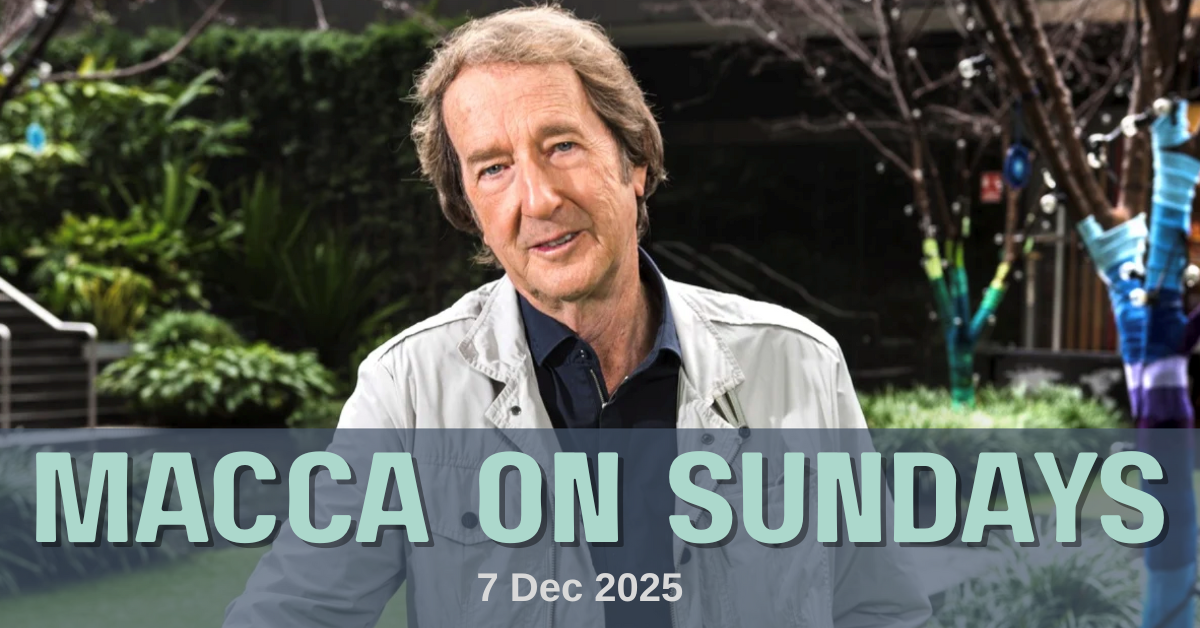
A Sunday morning like this feels stitched together by movement. Trucks rolling through the dark with concert gear. Ports stirring before the city wakes. Families on long Christmas roads, chasing shade, rain and a little cooler air. A boy taking his first solo flight. A town preparing to farewell one of its quiet heroes. And, as always, the sense that Australia reveals itself best when people simply ring in and talk about where they are, what they’re doing, and why it matters to them.
Forty Trucks, One Show, and the People Who Move the Music
Chris rang in from the highway, south of Coffs Harbour, heading north with show freight. He’d bumped out of Sydney overnight, Melbourne before that, and was due in Brisbane by morning. It wasn’t the music that interested him — he freely admitted he didn’t understand most of it — but the scale of what goes into it. Lady Gaga alone, he said, required around forty trucks of gear. Taylor Swift, even more.
He talked about smoke on the road, single-lane traffic, drizzle just beginning to fall, and the constant awareness that with heat, wind and fuel on the ground, it doesn’t take much for fire season to announce itself. It was the sort of call that quietly reminds you that every show, every spectacle, arrives on the back of people driving through the night, watching the weather, and hoping the road stays open.
Six Degrees in Romsey and a Tug Called Eureka
Paul rang from Romsey, Victoria, where it was six degrees and climbing slowly. He was on his way to work at the Port of Melbourne, where he works as a deckhand on a tug called Eureka. Christmas, he said, is always busy — more ships, more containers, more pressure to get goods in on time.
The biggest container ships now stretch eighteen containers across, stacked high on deck and packed deep below. Paul’s job is simple and essential: tying on, letting go, pulling lines back aboard. The kind of work that keeps global trade moving, but rarely gets mentioned. The contrast lingered. Forty degrees in Sydney the day before. Single digits in Victoria that morning. Same country. Same day.
Weather Watching in Brisbane and Switching the Screens Off
Brendan called from Brisbane with a precise weather update — the timing of the trough, the models, when the rain would clear. He mentioned a social electric scooter ride later in the day, then shifted to something weighing on his mind: under-16s being pushed off social media.
He’d seen firsthand how productivity changed when workers were cut off from constant internet access. Jobs finished faster. Quality improved. Focus returned. He wasn’t pretending the transition would be painless, especially for kids who’d grown up online, but he believed the reset mattered. Macca listened, quietly sceptical and quietly supportive at the same time, circling back to the idea that thinking for yourself still counts — and that maybe we’ve all forgotten how to sit with our own thoughts.
Heat, Cattle Trucks and Christmas Roads to the Territory
Carmel rang early from Camberwell, Queensland, before the heat had fully settled in. She and her partner were heading north to Katherine for Christmas, having left their van in Brisbane and continued in the LandCruiser. Outside Mount Isa the previous afternoon, the ground temperature had read 50.8 degrees.
Along the way they’d counted cattle trucks — dozens one day, fewer the next — fat cattle moving south as feed dried out further west. A brief storm had washed the dust from the windscreen, then passed on. Camberwell was quiet, trucks rumbling through the main street, the country waking slowly. It sounded like a scene Australians know instinctively: move early, rest when it’s too hot, keep going when you can.
Trading Sydney Heat for Tasmanian Space
Brett called from Snug, south of Hobart, looking out over Opossum Bay toward Bruny Island. He’d moved from Sydney a couple of years earlier, trading congestion and heat for acreage, views and cold winters. For the price of a two-bedroom unit near Cronulla, he’d bought 35 acres and a home.
He talked about electricity bills doubling after just a few weeks of heating, chopping wood instead of running air-conditioning, and still having snow dust Mount Wellington late into spring. That afternoon he’d be heading to a Margate Hills community gathering — a plant and produce swap, a barbecue, neighbours trading seedlings and stories. It wasn’t nostalgia he was selling. It was relief.
Three Hundred and Forty-Nine Nativities in Launceston
Margaret rang from Launceston with an invitation. Inside Holy Trinity Church, she said, sat 349 nativity sets, donated by a local woman and displayed with care and light. Sets from around the world. Indigenous artwork. Snow globes collected over decades. All open to the public through Christmas.
She spoke about visiting Bavaria, about Christmas markets that centred on story rather than spectacle, and about wanting to hold onto something deeper than tinsel. Whether people believed or not wasn’t the point. Tradition mattered. Memory mattered.
A Fifteen-Year-Old’s First Solo Flight
Andrew rang from Bundaberg with his son Clancy beside him. It was Clancy’s fifteenth birthday, and in forty minutes he’d be taking his first solo flight in a Cessna 172. When he started lessons, he’d needed cushions to see over the panel and extensions to reach the pedals.
Clancy had paid for his flying by cutting wood and picking lychees. He didn’t own a phone. Didn’t use social media. He’d watched his older siblings struggle with it and decided it wasn’t for him. One circuit alone. Then back on the ground. A small moment — and a huge one.
Remembering Ted Egan and a Life That Kept Moving
Tony Foran rang from Brisbane to remember Ted Egan — songwriter, educator, advocate and tireless traveller. He spoke about Ted arriving at Kelvin Grove Teachers College in the early 1960s as a mature-age student, having already lived a full working life in the Northern Territory.
Tony recalled Ted’s insistence that Aboriginal children deserved better educational opportunities, and how that conviction shaped his teaching, his music and his public life. Even in later years, Ted kept moving — driving thousands of kilometres to reunions, festivals and community gatherings, still performing, still telling stories, still tapping rhythms out on beer cartons.
Others rang with similar memories: of a man who didn’t slow down, didn’t stop listening, and didn’t stop believing that culture mattered. Like many of his generation, Ted left behind something more durable than recordings — a body of work that helped Australians hear themselves more clearly.
Heavy Music, Mosh Pits and Why It Matters
Adrian Cook phoned in from Sydney after attending the Good Things Festival. Loud bands. Packed crowds. Sweat, noise and joy. Tool, Weezer, Garbage. Music that wasn’t polite and didn’t pretend to be.
Macca asked what drew him to it. Adrian’s answer was simple: it feels alive. Not everything needs to be gentle. Sometimes people need to lose themselves in sound.
Medicine, Eyes and Catching Things Early
Dr Ian Francis, an associate professor of ophthalmology, joined the program from Sydney alongside Dr Susan Gayden, a consultant radiologist. Between them, they traced how medicine has changed in ways that are easy to miss until you need it. Ian spoke about how the eyes can reveal far more than vision problems — subtle changes in the iris or retina can point to serious underlying conditions, including cardiovascular disease. In some cases, spotting those signs early can prevent sudden blindness or even save a life.
He explained how conditions that once offered little hope are now routinely treated, provided patients arrive early enough. Macular degeneration, for example, was long something doctors could only watch progress. Today, early detection, daily self-checks and timely injections can stabilise or even restore sight. The science is advanced, but the message was simple: delays cost outcomes.
Susan spoke about radiology’s quiet revolution — from ultrasound to CT and MRI — and how imaging now allows doctors to see what’s happening inside the body quickly and accurately. Almost every hospital patient now passes through some form of imaging, often speeding diagnosis and sparing people unnecessary procedures. She talked about how technology has expanded access too, allowing specialists to work remotely while still overseeing care.
It wasn’t a technical lecture. It was a reminder. Look after the basics. Pay attention to changes. Get checked. Modern medicine is at its best when people come early — not when they wait until something can no longer be fixed.
Clifton Pauses for a Bomber Command Veteran
Craig rang from the Gold Coast with news from Clifton, near Toowoomba. Joffre Bell, a Bomber Command veteran, had died at 105. Known locally as a quiet, humble man, he was one of the last of his generation.
For his farewell, Clifton would stop. A missing-man formation would fly overhead. A Royal Australian Air Force Spartan aircraft would take part. Locals would line the streets as the cortege passed the cenotaph. It wasn’t about spectacle, but recognition — offered while it could still be felt.
History, Gallipoli and the Power of Memory
Pam Cupper rang to mark a series of December anniversaries that rarely announce themselves loudly: the end of the Battle of Verdun in France, and the evacuation of Gallipoli in December 1915. Verdun, she explained, was the longest battle of the First World War, a defining struggle for France where an estimated third of all French servicemen served.
Gallipoli was remembered for a different reason. Pam spoke about the evacuation — not as a retreat, but as a rare military success built on patience, discipline and deception. Silent periods conditioned the enemy. Sacks were laid over tracks and piers to muffle footsteps. Drip rifles continued firing after trenches were abandoned. Thousands of men were withdrawn under cover of darkness, with the last Australians leaving just before dawn on December 20.
Not all victories are loud. Sometimes survival depends on restraint and careful planning — qualities that save lives but rarely dominate the stories we tell.
Old Ships, New Towers and What Gets Lost
Captain Matt rang from Melbourne’s Docklands with concern for another kind of inheritance. As apartment towers continue to rise along the waterfront, heritage vessels — tall ships, steam tugs and working boats that have called the harbour home for generations — are being displaced, their berths reclaimed for development.
Matt spoke of these ships not as static museum pieces, but as living parts of the city’s story. They’ve taken young people to sea, passed on skills, and kept maritime history visible rather than sealed behind glass. A gathering was planned at midday — boats on the water, people on the wharves — not to reject growth, but to ask whether everything old must be pushed aside to make room for the new.
Brownie’s Letter and the Long View
Then came Brownie’s letter — written from the Kimberley, Thailand, the road between. A meditation on fire, landscape, music, ageing, AI, happiness and peace of mind. A reminder that while the world rushes, stillness remains available to anyone willing to stop.
Making Life Hold Together
By the time the phone lines quietened, the pattern was clear again. No headlines. No grand declarations. Just people doing their jobs, loving their families, remembering their dead, chasing cooler air, protecting what matters, and finding meaning where they can.
That’s Australia as it sounds on a Sunday morning — ordinary people, spread across the country, quietly making life hold together.
Listen to the podcast episode here.
Disclaimer: ‘Australia All Over’ is a program produced and broadcast by the ABC Local Radio Network and hosted by Ian McNamara. Brisbane Suburbs Online News has no affiliation with Ian McNamara, the ABC, or the ‘Australia All Over’ program. This weekly review is an independent summary based on publicly available episodes. All original content and recordings remain the property of the ABC. Our summaries are written in our own words and are intended for commentary and review purposes only. Readers can listen to the full episodes via the official ABC platforms.