





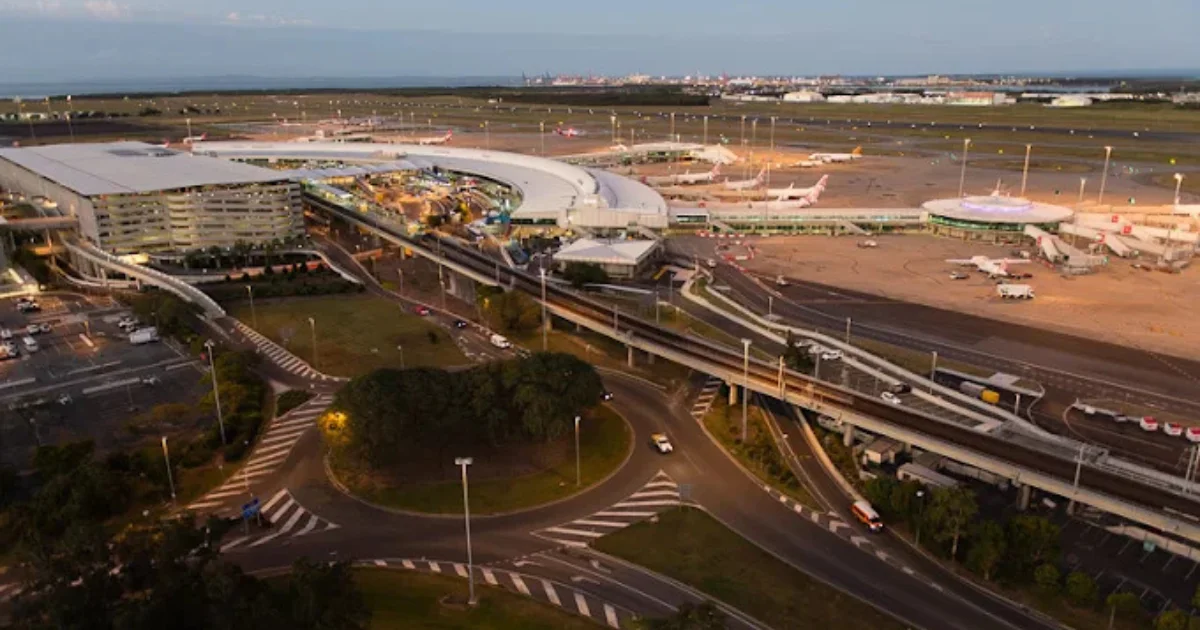
Brisbane Airport Corporation (BAC), in partnership with Airservices Australia and supported by Civil Aviation Safety Authority (CASA), has begun an 18-month voluntary trial to allow pilots to accept tailwinds of up to 10 knots overnight, with the objective of shifting more flights over water between 10:00 pm and 6:00 am, thereby reducing aircraft noise over surrounding suburbs.
Read: Landers Pocket to Open Near Brisbane Airport, Bringing Food, Sport, and Entertainment Together
The trial remains fully voluntary: no pilot or airline is required to take part, and participation rests solely at the pilot-in-command’s discretion. BAC emphasises the program operates entirely within existing regulatory settings and does not require any exemptions or changes to international aviation standards.

Historically, Brisbane Airport permitted a 10-knot tailwind allowance for around three decades before that limit was reduced to 5 knots in 2016 when the airport aligned with international standards. The new trial is intended to gather evidence on whether safely restoring the higher tailwind limit on a permanent basis is feasible, while simultaneously offering potential noise benefits to nearby communities.
How the 18-month tailwind trial will operate
The trial will roll out in two phases:
- First 6 months: the increased tailwind allowance applies only to departures.
- Following 12 months: the allowance will be available for both arrivals and departures, provided conditions remain suitable.
The overnight operational window is between 10pm and 6am, targeting the hours when aircraft noise tends to have the greatest impact on residential communities around the airport.
Conditions required for participation

Pilots may choose to accept a tailwind of up to 10 knots only if all of the following safety and operational conditions are met:
- Tailwind component is 10 knots or less (including gusts)
- Crosswind component is 20 knots or less (including gusts)
- Runway is dry
- No thunderstorms present or forecast within 30 nautical miles
- No reported or forecast windshear
- Adequate air-traffic control staffing
- Traffic levels remain at acceptable levels
When those criteria are satisfied, Airservices Australia will issue a notification via the Automatic Terminal Information Service (ATIS), indicating that the tailwind option is available. At no point is participation mandated.
Purpose of the tailwind allowance
The core intention of the trial is to increase the likelihood that aircraft will take off and land over water, namely Moreton Bay, rather than above residential areas. Over-water flight paths tend to impose lower noise burdens on suburbs near the airport, especially overnight.
In the six months leading up to the trial’s launch, BAC reports that approximately 63 per cent of aircraft movements between 10pm and 6am either arrived or departed over water. BAC hopes restoring a 10-knot tailwind allowance under controlled conditions will lift that proportion even further, where safely possible.
Data collection and evaluation

The trial has been developed and funded by BAC, with the aviation consultant PlanSafe tasked with creating the operational procedures and managing data collection. The programme aims to capture wind and operational performance data from participating aircraft.
Over the 18-month period, that dataset will be analysed to assess whether permanently reinstating the 10-knot tailwind limit, and thus more frequent over-water operations at night, is viable under safety standards.
Why the trial is timely
The tailwind trial forms part of a broader suite of noise-abatement measures at Brisbane Airport following changes to flight paths and the activation of its parallel runway in 2020. Over-water routing at night has featured prominently among strategies to reduce the noise impact on suburbs near the airport.
Read: Hands-On Training Takes Flight with Qantas 717 at Brisbane Airport
By gathering robust operational and safety data, BAC, Airservices Australia and CASA aim to balance the demands of aviation operations with community concerns about aircraft noise, potentially paving the way for a permanent tailwind policy that eases noise burdens while maintaining safety and compliance.
Published 10-December-2025

