


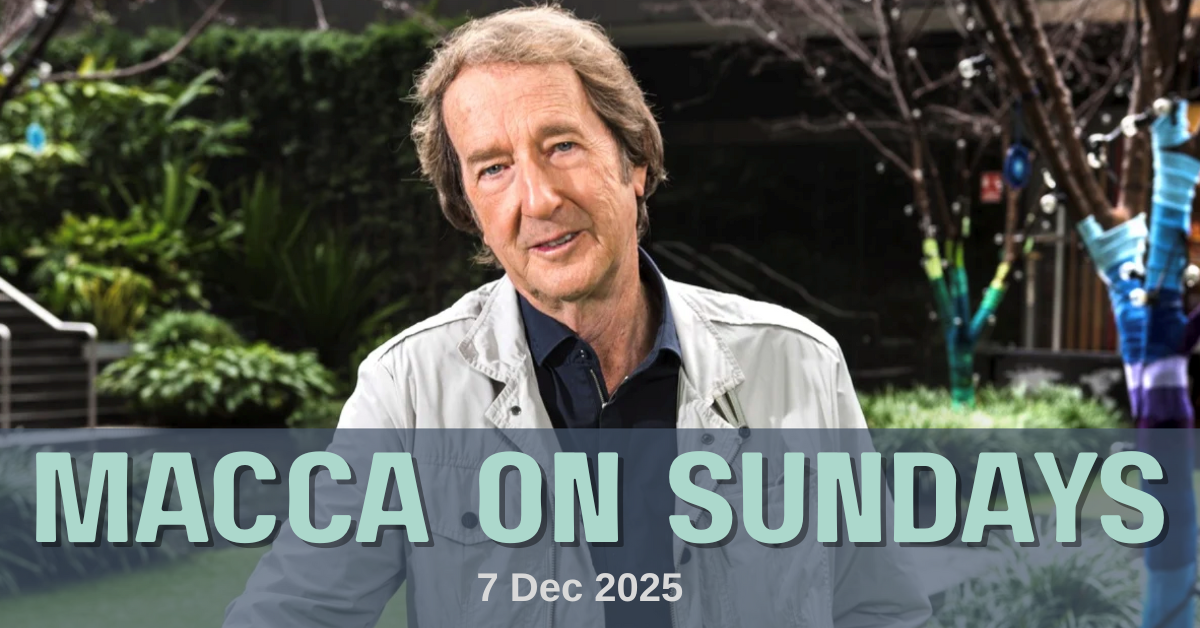

The December 7 Show

A Country Waking Up on a Sunday Morning

A Sunday morning like this feels stitched together by movement. Trucks rolling through the dark with concert gear. Ports stirring before the city wakes. Families on long Christmas roads, chasing shade, rain and a little cooler air. A boy taking his first solo flight. A town preparing to farewell one of its quiet heroes. And, as always, the sense that Australia reveals itself best when people simply ring in and talk about where they are, what they’re doing, and why it matters to them.

Forty Trucks, One Show, and the People Who Move the Music

Chris rang in from the highway, south of Coffs Harbour, heading north with show freight. He’d bumped out of Sydney overnight, Melbourne before that, and was due in Brisbane by morning. It wasn’t the music that interested him — he freely admitted he didn’t understand most of it — but the scale of what goes into it. Lady Gaga alone, he said, required around forty trucks of gear. Taylor Swift, even more.

He talked about smoke on the road, single-lane traffic, drizzle just beginning to fall, and the constant awareness that with heat, wind and fuel on the ground, it doesn’t take much for fire season to announce itself. It was the sort of call that quietly reminds you that every show, every spectacle, arrives on the back of people driving through the night, watching the weather, and hoping the road stays open.

Six Degrees in Romsey and a Tug Called Eureka

Paul rang from Romsey, Victoria, where it was six degrees and climbing slowly. He was on his way to work at the Port of Melbourne, where he works as a deckhand on a tug called Eureka. Christmas, he said, is always busy — more ships, more containers, more pressure to get goods in on time.

The biggest container ships now stretch eighteen containers across, stacked high on deck and packed deep below. Paul’s job is simple and essential: tying on, letting go, pulling lines back aboard. The kind of work that keeps global trade moving, but rarely gets mentioned. The contrast lingered. Forty degrees in Sydney the day before. Single digits in Victoria that morning. Same country. Same day.

Weather Watching in Brisbane and Switching the Screens Off

Brendan called from Brisbane with a precise weather update — the timing of the trough, the models, when the rain would clear. He mentioned a social electric scooter ride later in the day, then shifted to something weighing on his mind: under-16s being pushed off social media.

He’d seen firsthand how productivity changed when workers were cut off from constant internet access. Jobs finished faster. Quality improved. Focus returned. He wasn’t pretending the transition would be painless, especially for kids who’d grown up online, but he believed the reset mattered. Macca listened, quietly sceptical and quietly supportive at the same time, circling back to the idea that thinking for yourself still counts — and that maybe we’ve all forgotten how to sit with our own thoughts.

Heat, Cattle Trucks and Christmas Roads to the Territory

Carmel rang early from Camberwell, Queensland, before the heat had fully settled in. She and her partner were heading north to Katherine for Christmas, having left their van in Brisbane and continued in the LandCruiser. Outside Mount Isa the previous afternoon, the ground temperature had read 50.8 degrees.

Along the way they’d counted cattle trucks — dozens one day, fewer the next — fat cattle moving south as feed dried out further west. A brief storm had washed the dust from the windscreen, then passed on. Camberwell was quiet, trucks rumbling through the main street, the country waking slowly. It sounded like a scene Australians know instinctively: move early, rest when it’s too hot, keep going when you can.

Trading Sydney Heat for Tasmanian Space

Brett called from Snug, south of Hobart, looking out over Opossum Bay toward Bruny Island. He’d moved from Sydney a couple of years earlier, trading congestion and heat for acreage, views and cold winters. For the price of a two-bedroom unit near Cronulla, he’d bought 35 acres and a home.

He talked about electricity bills doubling after just a few weeks of heating, chopping wood instead of running air-conditioning, and still having snow dust Mount Wellington late into spring. That afternoon he’d be heading to a Margate Hills community gathering — a plant and produce swap, a barbecue, neighbours trading seedlings and stories. It wasn’t nostalgia he was selling. It was relief.

Three Hundred and Forty-Nine Nativities in Launceston

Margaret rang from Launceston with an invitation. Inside Holy Trinity Church, she said, sat 349 nativity sets, donated by a local woman and displayed with care and light. Sets from around the world. Indigenous artwork. Snow globes collected over decades. All open to the public through Christmas.

She spoke about visiting Bavaria, about Christmas markets that centred on story rather than spectacle, and about wanting to hold onto something deeper than tinsel. Whether people believed or not wasn’t the point. Tradition mattered. Memory mattered.

A Fifteen-Year-Old’s First Solo Flight

Andrew rang from Bundaberg with his son Clancy beside him. It was Clancy’s fifteenth birthday, and in forty minutes he’d be taking his first solo flight in a Cessna 172. When he started lessons, he’d needed cushions to see over the panel and extensions to reach the pedals.

Clancy had paid for his flying by cutting wood and picking lychees. He didn’t own a phone. Didn’t use social media. He’d watched his older siblings struggle with it and decided it wasn’t for him. One circuit alone. Then back on the ground. A small moment — and a huge one.

Remembering Ted Egan and a Life That Kept Moving

Tony Foran rang from Brisbane to remember Ted Egan — songwriter, educator, advocate and tireless traveller. He spoke about Ted arriving at Kelvin Grove Teachers College in the early 1960s as a mature-age student, having already lived a full working life in the Northern Territory.

Tony recalled Ted’s insistence that Aboriginal children deserved better educational opportunities, and how that conviction shaped his teaching, his music and his public life. Even in later years, Ted kept moving — driving thousands of kilometres to reunions, festivals and community gatherings, still performing, still telling stories, still tapping rhythms out on beer cartons.

Others rang with similar memories: of a man who didn’t slow down, didn’t stop listening, and didn’t stop believing that culture mattered. Like many of his generation, Ted left behind something more durable than recordings — a body of work that helped Australians hear themselves more clearly.

Heavy Music, Mosh Pits and Why It Matters

Adrian Cook phoned in from Sydney after attending the Good Things Festival. Loud bands. Packed crowds. Sweat, noise and joy. Tool, Weezer, Garbage. Music that wasn’t polite and didn’t pretend to be.

Macca asked what drew him to it. Adrian’s answer was simple: it feels alive. Not everything needs to be gentle. Sometimes people need to lose themselves in sound.

Medicine, Eyes and Catching Things Early


Dr Ian Francis, an associate professor of ophthalmology, joined the program from Sydney alongside Dr Susan Gayden, a consultant radiologist. Between them, they traced how medicine has changed in ways that are easy to miss until you need it. Ian spoke about how the eyes can reveal far more than vision problems — subtle changes in the iris or retina can point to serious underlying conditions, including cardiovascular disease. In some cases, spotting those signs early can prevent sudden blindness or even save a life.

He explained how conditions that once offered little hope are now routinely treated, provided patients arrive early enough. Macular degeneration, for example, was long something doctors could only watch progress. Today, early detection, daily self-checks and timely injections can stabilise or even restore sight. The science is advanced, but the message was simple: delays cost outcomes.

Susan spoke about radiology’s quiet revolution — from ultrasound to CT and MRI — and how imaging now allows doctors to see what’s happening inside the body quickly and accurately. Almost every hospital patient now passes through some form of imaging, often speeding diagnosis and sparing people unnecessary procedures. She talked about how technology has expanded access too, allowing specialists to work remotely while still overseeing care.

It wasn’t a technical lecture. It was a reminder. Look after the basics. Pay attention to changes. Get checked. Modern medicine is at its best when people come early — not when they wait until something can no longer be fixed.

Clifton Pauses for a Bomber Command Veteran


Craig rang from the Gold Coast with news from Clifton, near Toowoomba. Joffre Bell, a Bomber Command veteran, had died at 105. Known locally as a quiet, humble man, he was one of the last of his generation.

For his farewell, Clifton would stop. A missing-man formation would fly overhead. A Royal Australian Air Force Spartan aircraft would take part. Locals would line the streets as the cortege passed the cenotaph. It wasn’t about spectacle, but recognition — offered while it could still be felt.

History, Gallipoli and the Power of Memory


Pam Cupper rang to mark a series of December anniversaries that rarely announce themselves loudly: the end of the Battle of Verdun in France, and the evacuation of Gallipoli in December 1915. Verdun, she explained, was the longest battle of the First World War, a defining struggle for France where an estimated third of all French servicemen served.

Gallipoli was remembered for a different reason. Pam spoke about the evacuation — not as a retreat, but as a rare military success built on patience, discipline and deception. Silent periods conditioned the enemy. Sacks were laid over tracks and piers to muffle footsteps. Drip rifles continued firing after trenches were abandoned. Thousands of men were withdrawn under cover of darkness, with the last Australians leaving just before dawn on December 20.

Not all victories are loud. Sometimes survival depends on restraint and careful planning — qualities that save lives but rarely dominate the stories we tell.

Old Ships, New Towers and What Gets Lost


Captain Matt rang from Melbourne’s Docklands with concern for another kind of inheritance. As apartment towers continue to rise along the waterfront, heritage vessels — tall ships, steam tugs and working boats that have called the harbour home for generations — are being displaced, their berths reclaimed for development.

Matt spoke of these ships not as static museum pieces, but as living parts of the city’s story. They’ve taken young people to sea, passed on skills, and kept maritime history visible rather than sealed behind glass. A gathering was planned at midday — boats on the water, people on the wharves — not to reject growth, but to ask whether everything old must be pushed aside to make room for the new.

Brownie’s Letter and the Long View


Then came Brownie’s letter — written from the Kimberley, Thailand, the road between. A meditation on fire, landscape, music, ageing, AI, happiness and peace of mind. A reminder that while the world rushes, stillness remains available to anyone willing to stop.

Making Life Hold Together


By the time the phone lines quietened, the pattern was clear again. No headlines. No grand declarations. Just people doing their jobs, loving their families, remembering their dead, chasing cooler air, protecting what matters, and finding meaning where they can.

That’s Australia as it sounds on a Sunday morning — ordinary people, spread across the country, quietly making life hold together.

Listen to the podcast episode here.

Disclaimer:Australia All Over’ is a program produced and broadcast by the ABC Local Radio Network and hosted by Ian McNamara. Brisbane Suburbs Online News has no affiliation with Ian McNamara, the ABC, or the ‘Australia All Over’ program. This weekly review is an independent summary based on publicly available episodes. All original content and recordings remain the property of the ABC. Our summaries are written in our own words and are intended for commentary and review purposes only. Readers can listen to the full episodes via the official ABC platforms.

The November 30 Show

Ordinary Lives, Extraordinary Threads: This Week in the Australian Phone Box


Some Sundays arrive like a deep breath — not loud, not polished, just steady. A man pulls over on a long inland road because a stranger’s dog has fallen out of a ute. A tug skipper in Port Hedland talks horsepower and tides like it’s poetry. A daughter keeps watch over the last of the Bomber Command generation, while another quietly reminds us that planes didn’t fly on bravery alone — they flew because people on the ground made sure they could. And threaded through it all are small acts that don’t ask for applause, but somehow hold a country together.

Bruno, the Ute, and the Kindness You Don’t Forget


Stibbsie from Charters Towers told the kind of outback story that starts as a favour and ends as a legend. Years ago, fuelling up at the Belyando Roadhouse, a bloke asked him to keep an eye out for his dog, Bruno — who’d fallen out of a cage on the back of the ute. There was a crumpled phone number. A tenner pushed into a shirt pocket. And the sort of request you can’t quite shake, even when you drive off.

Days later, a surveyor mate rang: he’d found a dog in the scrub — not looking flash — and could Stibbsie pick him up and get him to a vet? He drove out, taped Bruno’s mouth just in case, and loaded him like dead weight into the tray. But a kilometre down the road, Stibbsie looked back: Bruno was standing up on the ute like he owned it — tongue out, wind in his face, thrilled to be moving again.

At the vet, Bruno jumped down, walked in like a regular, and was declared basically fine — maybe just hungry. Owner reunited. A $150 reward offered and accepted, then shared with the mate who’d made the call. A happy ending — and a reminder that sometimes the biggest moments happen on the side of a highway, between people who’ll never be famous, but do the right thing anyway.

Port Hedland, Big Ships, and a Tug That Pushes the World Around

Photo Credit: Vessel Finder

In Port Hedland, Macca spoke with Andrew Colliver — master of a harbour tug, the Boodarie — 27 metres long, 5,000 horsepower, built for the slow, precise work of moving enormous ships in and out. Across the way were 300-metre bulk carriers, loading around 200,000 tonnes of iron ore at a time.

Andrew grew up in Shark Bay, started in dinghies, moved into fishing boats, then spent years on prawn trawlers before shifting into tug work and offshore oil-and-gas support on the North West Shelf. He spoke about tides like they were alive — because in a place like Port Hedland, they are. You don’t move ships unless the water’s there.

It turned a headline industry into something human: one bloke in a wheelhouse, quietly doing a job that keeps the nation’s exports moving.

The Bomber Command Families, and the People Who Kept Them Flying


Annette Gutierrez called with a quiet mission: to help identify how many Australian Bomber Command veterans are still alive following the death of Joffre Bell in Queensland at the age of 105. Her understanding was that there may be as few as a dozen remaining, including centenarians who recently attended a Bomber Command luncheon in Sydney, and at least one widow aged 100. Records are incomplete, and many families don’t note service details in death notices. Her hope was simply that their service be acknowledged while it still can be.

Ian from Huntleys Cove then shared a fresh loss. His father-in-law, Philip Smith, had died in Burradoo just a month short of his 102nd birthday. Philip was a wireless operator on Lancaster bombers — modest, private, but willing to share his logbooks and memories so his granddaughter could complete her final-year history assignment. Not for recognition — just because the story mattered.

Lynne from Bowral widened the lens again. Her mother, Betty — now 102 and living independently in Logan Village — worked as an electrician during the war at RAAF Base Sale, maintaining aircraft. Lynne’s point was simple and powerful: the planes didn’t stay airborne on courage alone. They flew because people like Betty kept them airworthy — and when the war ended, many women were told there was no place for them in the trade. Betty retrained as a hairdresser. Life moved on. The contribution remained.

A Veggie Garden for Mum, and the Everyday Work of Love


Bill rang from near Ebor, on his way to Port Macquarie with tools in the car and a plan: to build a vegetable garden for his 93-year-old mum. Not as a grand gesture — but as a way to keep her interested, active and connected. Tomatoes. Beans. Rhubarb for a proper rhubarb-and-apple pie. Neighbours helping out. Home support keeping the rhythm of her days.

He spoke about his mum still getting on her hands and knees to weed, moving through a three-storey home fitted with a lift, determined to keep living life on her own terms. It wasn’t really about vegetables. It was about dignity.

“Kerosene Blue” Water in the Torres Strait

Out on the water near Yam Island, Gossie called from the Cape Graft, now operating as a mothership for the start of the free-diving crayfish season. He borrowed a phrase from a local Islander to describe the conditions: “kerosene blue” — flat, calm, beautiful.

Free-diving would run through December and January, with hookah diving beginning later in the year. The catch would head south to market. It was work, yes — but the way he described it, it sounded like a place you could breathe.

The Electric Toothbrush and the Bee Problem

Andy from Millongandy offered a bush solution to a worrying observation: fewer bees around the garden. His tip was practical and oddly ingenious — using an electric toothbrush (with the head removed) to gently vibrate tomato or capsicum flowers, mimicking the action of bees and helping pollination.

It was funny — but also quietly sobering. Because the trick only works if bees aren’t there to do the job themselves.

Forty-Two Marathons for the Fallen


Susan Chuck shared the story of a Brisbane serviceman, Ben Sedonari, who ran a marathon every day for 42 consecutive days, finishing at the Afghanistan Memorial near Suncorp Stadium. The effort honoured those lost to conflict, injury, and suicide, raising close to $14,000 for veterans’ support.

It sounded impossible — until he simply did it. One day at a time.

On the Road: Ammonium Nitrate and the Long Haul


Alan called from the cab of his truck, travelling from Moree to Gladstone to load ammonium nitrate, then north toward a mine near Collinsville. A V-double. Long hours. Roads that range from good to rough.

He didn’t romanticise the work. Trucking is something you either settle into or move on from. Before hanging up, he asked if Macca might ever do caps for truckies — a small request, but one that spoke to the desire to feel part of something larger than the road ahead.

Neville’s 26-Year “Three Months to Live”


Neville’s call carried quiet resilience. Diagnosed with multiple myeloma in 1999 and given just months to live without treatment — and perhaps four years with it — he was still here 26 years later. He’d recently finished restoring a 1949 Riley sedan and was already planning the next project.

His outlook was simple and earned: you get nothing out if you put nothing in.

AI Music, Real Music, and the Live Thing


The conversation drifted into AI-generated music, sparked by Charlie, an Uber driver from Cairns who’d been experimenting with AI songwriting tools. Some callers loved the sound and the feeling it created, regardless of how it was made.

Adrian from Tully Heads — a conductor and arranger — offered the counterpoint. His concern wasn’t novelty, but what gets lost: musical literacy, craft, and the human emotion that lives inside performance. An AI song might be clever, he said — but it isn’t human.

Macca brought it back to something stubborn and old-fashioned: live music still matters. A room full of people hearing sound move through air is something no algorithm can replace.

Milano–Cortina, Snowboard Cross, and the Team Behind the Team

Justin from Sydney explained snowboard cross — four riders launching together down a course of jumps, berms and bumps. Strategy, timing and controlled aggression matter as much as speed.

A physiotherapist with the Australian snowboard cross team, Justin spoke about preparing for the Milano–Cortina Winter Olympics, beginning in February 2026. He described the injuries viewers never see — fractured spines, complex recoveries — and the challenges of treating athletes in cold, remote conditions.

Behind every Olympic moment, there’s a team quietly holding things together.

Borroloola Storm Clouds, Crocodiles, and a New Cyclone Shelter

From Borroloola in the Gulf Country, Samuel described wet-season skies building with thunder and lightning — and welcomed news that a long-awaited cyclone shelter had finally been completed, large enough to hold around 500 people.

He also spoke plainly about crocodiles. Numbers are higher now than decades ago, and living alongside them means lost nets, closed swimming holes, and constant awareness. There was no panic in his voice — just respect.

Cans in the Todd River and Paying for Christmas Lunch


Cameron from Alice Springs shared a tradition he and his wife had built: walking the Todd River collecting cans and bottles. Over time, they gathered more than 3,000 — about $300 worth — enough to pay for Christmas lunch at a local resort.

He spoke about cicadas emerging, kingfishers hunting, and the difference between passing through a place and actually living there. In passing, he mentioned his father’s wartime work on G for George at RAAF Base Amberley — and how long recognition can sometimes take to catch up with service.

Richmond’s School of Arts and the Power of Live Music


Dave — usually based in Gove, temporarily on the Sunshine Coast — rang after spotting Macca’s image on the side of the Richmond School of Arts, promoting a Christmas fundraiser concert. He spoke fondly of the hall: its acoustics, its history, and the way music sounds when it’s played properly in a room built for it.

The call drifted through memories of Richmond, community halls, and nights when live music reminds you the world still fits together.

A Sailor’s Shock: Remembering Cookie


Andy from Port Lincoln rang with heavy news. The local sailing community had lost one of its most free-spirited members, Deidre “Cookie” Sibley, while she was aboard a French-flagged yacht in waters off East Africa.

An automatic distress signal was triggered. When the vessel was later boarded, two people were found deceased. At the time of the call, the circumstances remained unclear. Cookie was remembered as fit, fearless and generous — a PE teacher, diver and sailor who helped visiting yachties find moorings and feel welcome.

It was the kind of story that leaves a long silence behind it.

Over-65 Cricket, Christchurch, and Old Mates Reappearing


James from Hobart wrapped the morning with cricket. Tasmania’s over-65s had travelled to Christchurch for the Australasian Championships. With a small playing pool, they finished seventh — but won a match, made friends, and relished the camaraderie.

Four games in five days took their toll. But the moment that mattered most came when James found himself bowling to a former schoolmate from Lismore — decades after they’d last shared a field.

Life, quietly, had folded back on itself.

Ordinary People From All Over Australia


That’s the strange, beautiful rhythm of a Sunday morning phone line. The country arrives in fragments — a garden bed, a tug’s engine room, a war story carried carefully, a marathon measured out day by day. And when the calls fade, what lingers is the sense that Australia is still held together the way it always has been — by ordinary people, from all over the country, doing what they do, and doing it with heart.

Listen to the podcast episode here.

Disclaimer:Australia All Over’ is a program produced and broadcast by the ABC Local Radio Network and hosted by Ian McNamara. Brisbane Suburbs Online News has no affiliation with Ian McNamara, the ABC, or the ‘Australia All Over’ program. This weekly review is an independent summary based on publicly available episodes. All original content and recordings remain the property of the ABC. Our summaries are written in our own words and are intended for commentary and review purposes only. Readers can listen to the full episodes via the official ABC platforms.

Macca on Sundays: A Country in Full Voice

An omnibus recap of Australia All Over – June 22 to July 27, 2025

Over six crisp mid-winter Sundays, Australia All Over became a living map of the continent. From flooded cane paddocks to Red Centre stargazers, suburban sea scouts to outback vets, the country phoned in with wit, warmth, and more than a few unexpected moments. These are the stories that stood out across the weeks.


🔧 Bush Ingenuity & Outback Life

In the July 6 episode, Dennis from Cunnamulla called in to describe a makeshift solution for fencing repairs. Armed with a chain, a shovel, and the bonnet of an old EH Holden, Dennis turned what looked like a lost cause into a functioning gate. It wasn’t pretty, but it kept the cattle out. “It’s the sort of thing my dad would’ve called ‘bush elegant,’” he laughed.

Meanwhile, Harry from Quilpie told of the intense work done by aerial vets helping restock western Queensland with vaccinated cattle. He painted a picture of low-flying choppers and dusty yards, where the only reprieve was the water truck and the occasional scone from the local CWA.


🛠️ Odd Jobs & Unexpected Careers

One of the year’s most memorable stories came from Tom, a 76-year-old from Junee, who confessed on July 13 that he’d just taken on a “part-time job welding trailers for a bloke half my age.” He said it keeps his hands steady and mind sharper than Sudoku. “No plans to retire until my knees give out,” he chuckled. Macca asked how long that might be. “Give me another decade.”

In the same episode, Margie from Townsville rang in about her retirement passion: she collects defunct vending machines, restores them, and gives them away as novelty pantries to families doing it tough. “You open the door and there’s tins of spaghetti instead of Coke,” she explained.


🍉 Queenslanders and Watermelon Skis

On June 29, a young caller from Childers shared the most unusual agricultural invention of the season: melon skis. During a school fete, the kids hollowed out watermelons, slipped them onto their feet, and raced across a soaked tarpaulin. “We ended up with more bruises than winners,” she laughed, “but it raised $500 for the SES.”


🛰️ Big Skies, Deep Listening

The July 20 show featured Robyn, phoning from a stargazing gathering near Oodnadatta. There, a group of amateur astronomers had set up camp with telescopes aimed at the centre of the galaxy. “There’s no light out here—none,” she said, “You feel like you’re falling upward.” Later, Dr. Ian phoned in from Uluru, where he’d spoken at a remote health symposium. His voice cracked slightly when recounting a 19-year-old Anangu man’s story of surviving a heart condition through community health access.

On July 27, a marine engineer from Port Hedland rang to say he was overseeing underwater drone testing beneath supply barges. “We can now scan the hulls in real time—saves us time, fuel, and the divers.”


🚂 Trains, Trucks & Tin Sheds

Fabian and Greg, train drivers from Wagga Wagga, called while hauling freight across Victoria on July 13. Their story wasn’t just about engines—it was about friendship and rhythm. “We’ve been on the same run for 18 years,” said Greg. “We don’t talk much anymore—just hum the same songs.” Later that day, Sandra from Port Augusta spoke about working alone in a highway rest stop. “We see everything—from city dads trying to fix flat tyres, to grandmothers hitchhiking with chooks.”

In a July 27 segment, Trevor from Roma proudly described rebuilding a shearing shed entirely from salvaged tin and scrap timber. “Cost me $700 and six weeks. Looks like hell, but it’ll stand longer than me.”


🌾 Cultural Roots & Quiet Histories

In the June 25 episode, a Wiradjuri elder named Elsie phoned in to share a story about a ceremonial possum skin cloak her great-grandmother had helped stitch, now held at the National Museum. “She used to say the patterns were maps of memory,” Elsie said. “Not just for finding places, but for finding yourself.”

Rosemary from Temora called on July 6 to talk about reviving a community wheat festival last held in 1983. “We’re baking bread the old way—coals, iron pots, and a recipe from the back of my auntie’s wedding album.”


🛶 Across Oceans & Inland Waters

July 20 brought a remarkable call from a young sailor, broadcasting via sat phone from the middle of the Coral Sea. He and his crewmates were delivering a wooden sloop from New Caledonia to the Whitsundays. “We’ve had dolphins all day and radio silence all night,” he said. “Feels like living inside a storybook.”

On July 6, a woman named Carla from Gundagai reported that the local rowing club had found a hand-carved oar buried beneath their boat shed—dated 1912. “It’s now hanging above the fireplace,” she said. “With all the names etched down the shaft.”


🧭 The Spirit of the Show

Across all six weeks, Macca’s Sunday morning broadcasts formed a quilt of Australia in winter: full of hand-made fixes, voices on dusty roads, and a sense that life out bush and by the sea isn’t measured by headlines or economies—but by stories passed down in phone calls.

There were hard yarns, like the farmer from Biloela whose sugarcane crop drowned in flash flooding. There were soft ones, like the girl in Lorne who found a bird with a broken wing and taught it to perch on her handlebars.

Through it all, Australia All Over continued to do what it’s done best for decades: open the phone lines, and let the country speak for itself. 

Listen to the podcast episode here.

Disclaimer: Brisbane Suburbs Online News has no affiliation with Ian McNamara or the “Australia All Over Show.” This weekly review is an attempt to share the wonderful stories that Ian broadcasts each week and add value to what is a smorgasbord of great insights. 

Residents Appeal Against Approved 24/7 McDonald’s Development in Hendra

The battle against a proposed 24/7 McDonald’s in Hendra is far from over, as residents have officially lodged an appeal against the decision to approve the development.


Read: 24/7 Maccas at Nudgee Road in Hendra Gets Green Light, Locals Push Back


The latest legal challenge, submitted earlier this month to the Planning and Environment Court, argued that the development application (A006543699) should be refused because of several reasons. One of these is the fact that the site falls within a character residential zone primarily occupied by detached houses. Petitioners claim that approving a commercial development in such a setting contradicts local planning regulations and community expectations.

Photo credit: Google Street View

In January 2025, Brisbane approved plans for the fast-food outlet, which will be located at 330 Nudgee Road. The single-storey building will offer drive-thru services, counter takeaway, and meal order collection for delivery drivers. While the approved hours of operation would be 24/7, the counter takeaway services would be limited from 6:00 a.m. to 8:00 p.m.

Artist’s impression of proposed development (Photo credit: Brisbane PD Online)

However, despite receiving the green light, the proposed 24/7 McDonald’s has faced strong opposition from the local community, with over 400 submissions lodged against the proposal. Residents have raised several concerns, including the site’s proximity to schools, increased traffic congestion, safety risks, and potential environmental pollution. Additionally, many fear that the presence of a 24/7 fast-food outlet will negatively impact property values in the area.

Locals even launched an online campaign through GoFundMe, in hopes of raising funds to engage a lawyer and independent experts to contest the development. As of writing, they have raised over $21,000.


Read: Local Groups Mobilise Over Hendra McDonald’s Proposal


“Your contribution will support the costs needed to draft and file a notice of appeal, engage the required independent experts, hold a mediation meeting with the applicable parties and if necessary take this to trial,” Jackie, the fundraising organiser wrote.

“Together, we can work to protect Hendra and prevent this disruptive development from moving forward.”

As the appeal process unfolds, the dispute over the McDonald’s development in Hendra continues, with residents determined to have their concerns heard in court.

Published 24-March-2025