Chronic back pain has become endemic in society and so the recent Brisbane launch of a brand new service called Kieser, at 1 Zillman Rd in Ascot, will bring relief to many.
From golfers, gardeners, and sports people, to those lifting and carrying heavy items and to people who harm their back with bad posture or poor technique in the gym, Kieser has developed a process combining physio with specially developed machines to strengthen the support structure and enable an injury to be treated.
“Nearly half of all Australians have one or more chronic health conditions. At Kieser, our Physiotherapy and Exercise Physiology team is well equipped to help individuals manage their chronic health conditions. In particular, our strength training programs are ideal for those with osteoporosis or low bone density as progressive strength training in a safe environment is one of the best things you can do to maintain your bone mineral density,” says Clinic Leader, Jedd Michell.
Photo Credit: Supplied
For the next four weeks following the launch in Ascot, Kieser is offering a 50 per cent discount on their initial assessment to encourage locals to give it a go. They deal with all private health funds as well.
The company already has 23 centres mainly in the southern states of Australia, having opened its first clinic in 2006. The growth of the service has enabled thousands of people to live a pain-free life.
Photo Credit: Supplied
So, what’s different about Kieser?
The physios have been trained in the Kieser fundamentals and fully understand how a wide range of musco-skeletal conditions can be treated with a combination of manipulation and targeted muscular strengthening, enabling the treatment to sustain improvement rather than a quick fix that re-occurs later.
The equipment in the gym enables most people to get what they need from a 30-minute session, twice per week.
The gym has been designed to remove distractions like music and juice bars so that clients can use the specially designed machines that focus heavily on technique, with support available, as well as one-on-one training for those that need it.
Kieser Exercise Physiologists also specialise in both the prevention of chronic conditions as well as rehab recovery following surgery.
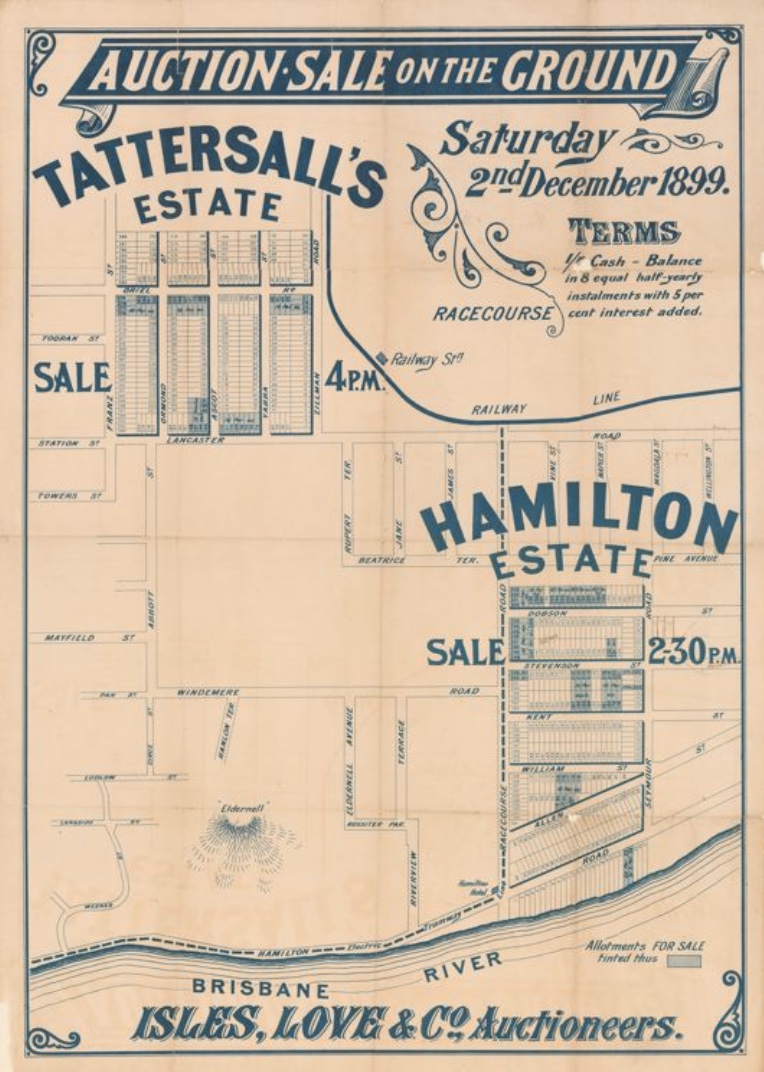
The history of Tattersalls Lodge, a 19th-century, heritage-listed cottage found at the corner of Oriel Road and Yabba Street in Ascot, is closely associated with the development of Queensland’s racing industry. Find out how.
In the late 1800s, bookmaker Charles Burton purchased four allotments of land in Ascot, owned by The Federal Building Land and Investment Society Limited, to build the Tattersalls Stables. Given its proximity to Eagle Farm Racecourse, Burton seized the opportunity to lease the site to horse trainers.
Two years later, Burton sold the property to the “Pearl King” James Clark, who was a horse-racing enthusiast and bred training horses. Mr Clark built the Federation-style Tattersalls Lodge on his newly-acquired property as a private training facility with houses for the horse trainers and their families.
Tattersalls Lodge earned a reputation for its prize-winning horses until Clark’s death.
Gilbert Powell Wyndham Heathcote, a hotelkeeper from New South Wales, bought Tattersalls Lodge from Clark. However, following Heathcote’s death in 1901, the property was auctioned off.
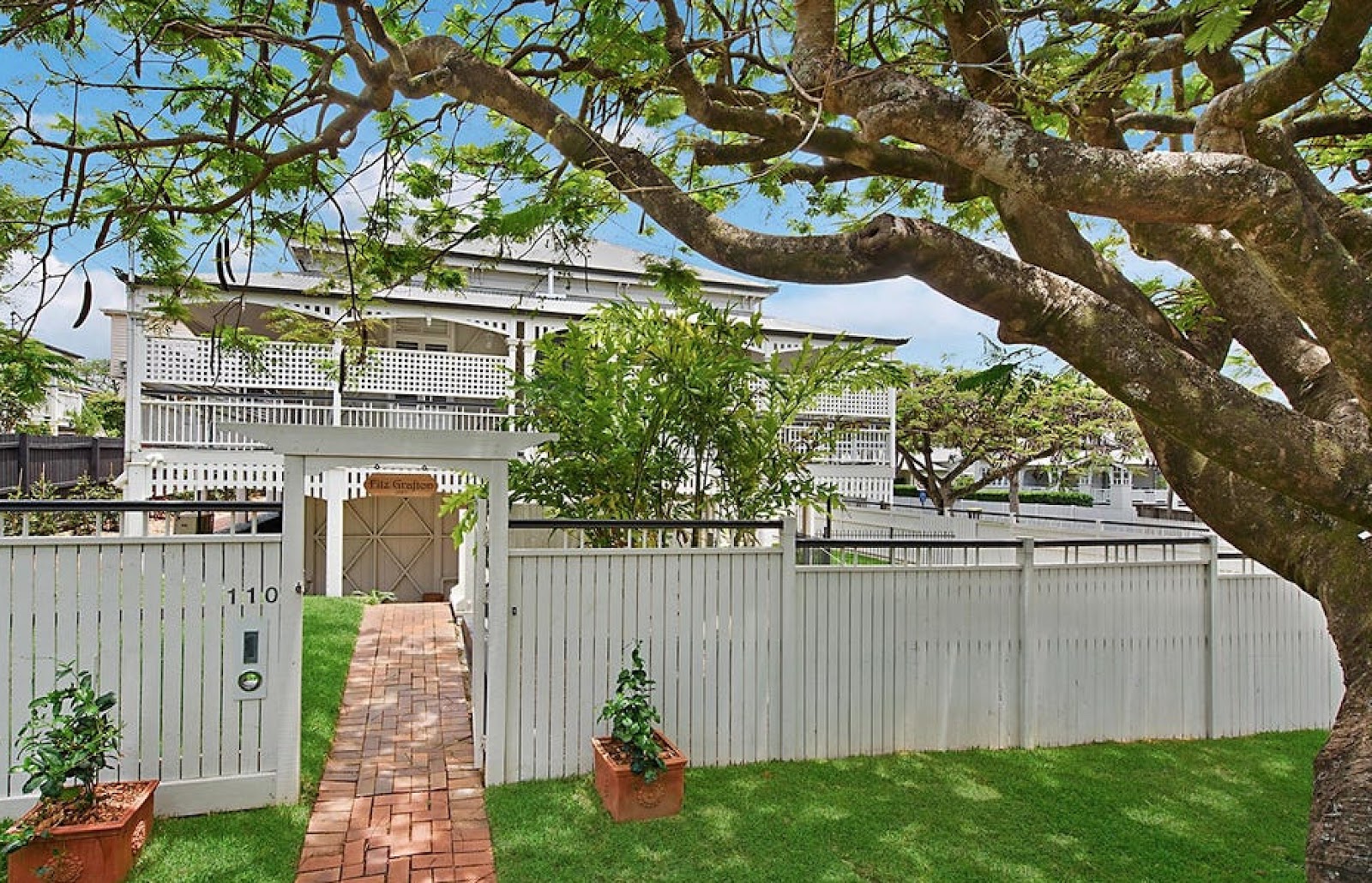
Grazier James McGill, known as the “Squire of Blacklands”, acquired Tattersalls Lodge and moved in with his family in 1903. Mr McGill was well-respected in the racing community, described as “one of the most honourable, straight-going sportsmen in the history of racing in Queensland.” He changed the name of the house to “Fitzgrafton Lodge,” after his prize-winning horse. McGill Avenue, adjacent to Lancaster Road in Ascot, was named after him.
Photo Credit: National Library of Australia
Photo Credit: National Library of Australia
When McGill died in 1918, his son James Charles McGill, inherited the property and held it until 1925. Countless owners have since acquired the property, turning the stables into private residences.
Tattersalls Lodge at Present
In January 2004, the property was entered into Brisbane’s local Heritage Listing.
Photo Credit: realestate.com.au
The present-day Tattersalls Lodge has been refurbished as a country-style home with Colonial French doors and wrap-around latticed verandahs.
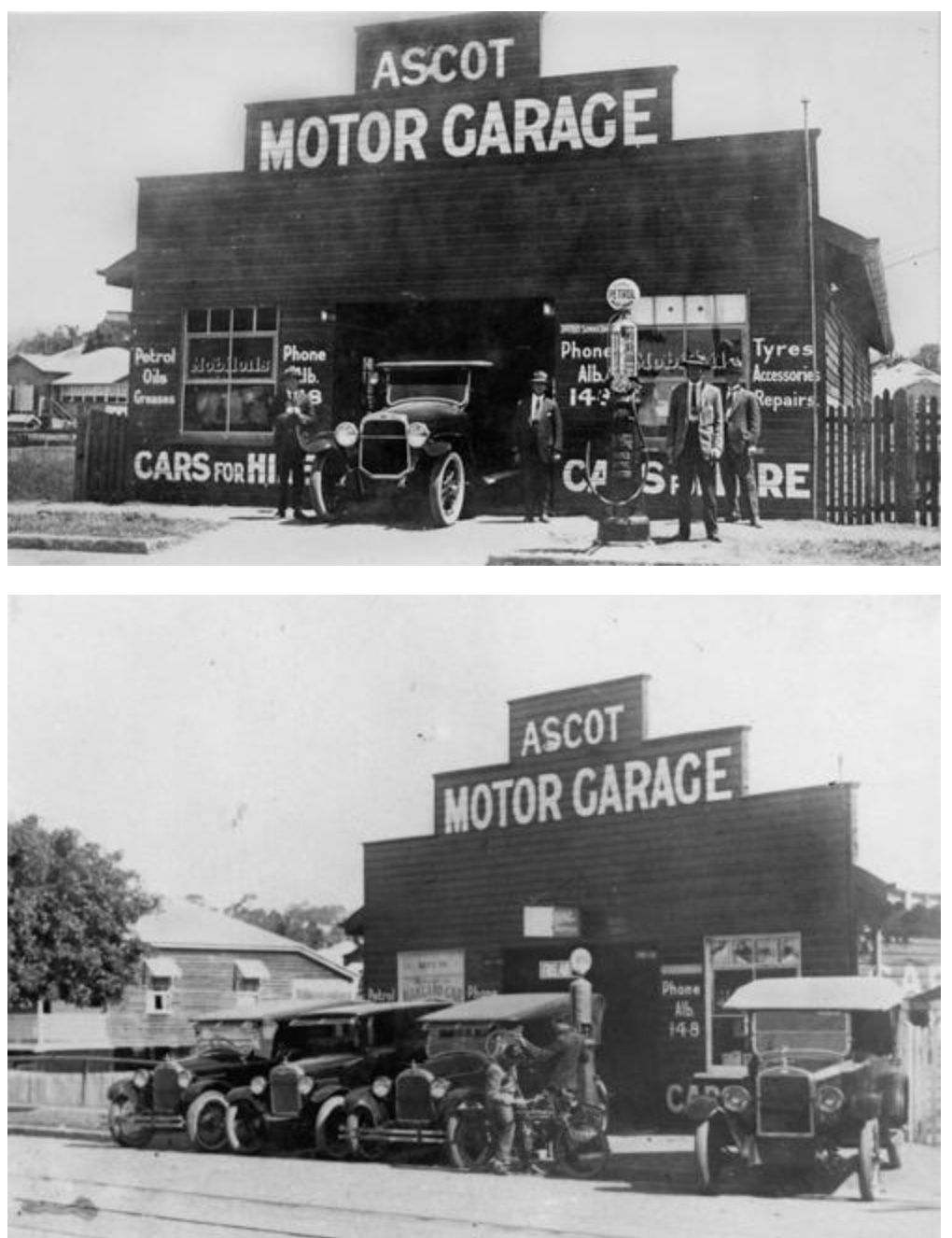
Did you know that the first taxi service in Queensland was established on Racecourse Road in Ascot? Once a quiet street with a handful of houses in the 1880s, Racecourse Road became a busy hub when the Ascot Taxi Service opened in 1919.
Two mechanics, Edmund William Henry Beckham and Edward Roland Videan, only had one vehicle and a common dream when they started the Ascot Taxi Service.
Within five years, their fleet had grown to four cars: three Willys Knight tourers and an Overland, the first sedan taxi in Brisbane.
The motorised vehicles completely replaced the hansom cab, the popular form of horse-drawn carriers from the previous century.
Motorised taxi services during this time didn’t have any way of checking the mileage for each trip other than for the driver to calculate the fare manually based on a fare scale. Despite the challenges, the birth of the state’s first motorised taxi service was a welcome and exciting change.
Moving to Fortitude Valley, Thriving Through Changes
As the business progressed, the Ascot Taxi Service moved to a new site in Fortitude Valley in the 1930s, where the company flourished despite the arrival of the Yellow Cab Company from Chicago in the United States.
Ascot Taxi Service and its new owners opened a two-storey, art-deco headquarters on Barry Parade, displaying its fleet of black taxi limousines. Its focus was on “taxi-tourist” trade and they were a popular choice for wedding hiring and similar events.
Drivers were required to wear uniforms, enhancing the prestige of the service. It was also the first company to introduce two-way radio in taxis in Queensland in the 1950s.
Photo Credit: State Library of Queensland
Barry Parade had other motor businesses, all built prior to World War II, such as the Phillip Frank and Co, New England Motor Company, and the OK Rubber Company.
The businesses became the centre of the motor trade in the city but over the years, as the city developed and infrastructure grew, people’s needs changed.
In the 1990s, Ascot Taxi Service became Q Cabs before merging with and becoming part of Black & White Cabs, which continues to operate from its head office at the Brisbane Airport.
In 2017, the Ascot Taxi Service building was demolished to make way for apartment development. The building’s last known occupant was Valley Radiator Services.
From Ascot Taxi Service to Ascot Motor Garage: The Evolution of Racecourse Road
Photo Credit: State Library of Queensland
The Ascot Motor Garage was a landmark and such a big part of the evolution of Racecourse Road in the early 20th century. It was set amidst some of the most expensive houses in Brisbane in large blocks of land are found.
By the time the taxi service moved out, however, Racecourse Road’s business landscape had changed, with general stores, fresh food supplies, and establishments for butchers, bakers, confectioners, chemists, and a laundry shop now dotting the neighbourhood.
Photo Credit: Google Maps
Eventually, other modern establishments set up shop on the busy boulevard with lovely Poinciana trees that bloom beautiful red flowers at Christmas time. Here, medical and dental clinics, salons, banks, and boutiques, as well as dozens of eateries, have made the area a high-end lifestyle hub.
More than 130 retail shops have graced Racecourse Road. Blocks of land have been redeveloped in the neighbourhood that the Ascot Taxi Service’s vehicles once traversed.
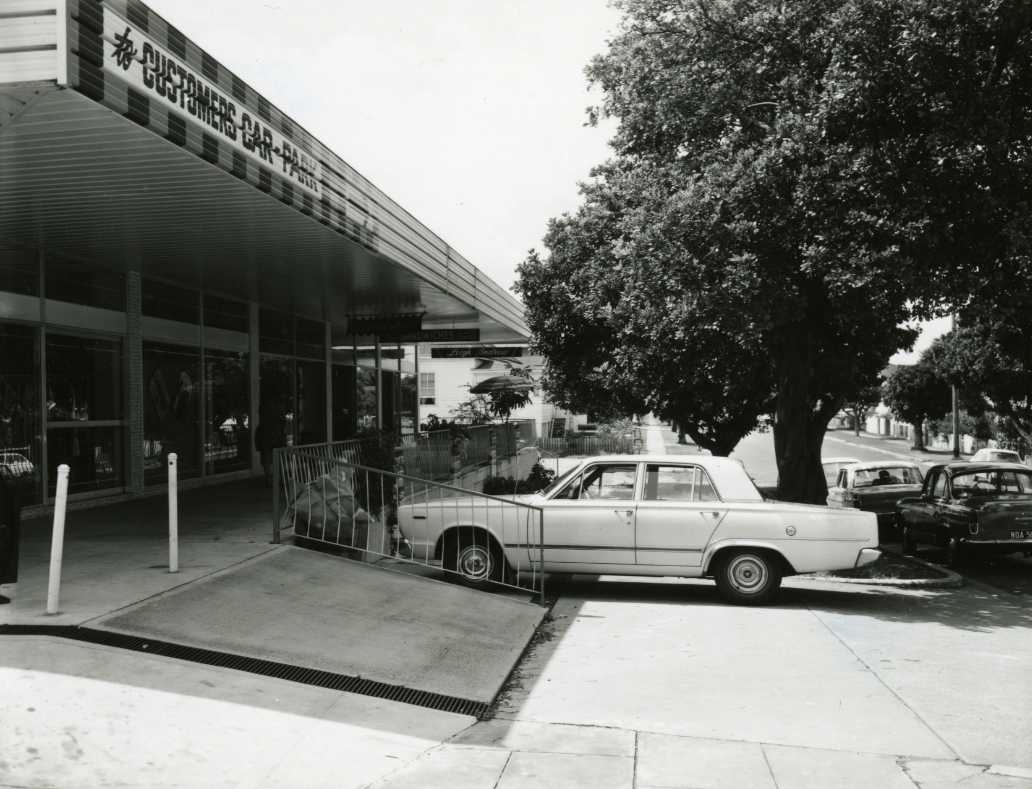
The 3,126-sqm property at 77 Racecourse Road on the corner of Kent Street in Ascot is presently the site of a 1960s building previously occupied by Woolworths before IGA and BWS took over. Silverstone acquired the site through an Expression of Interest in late 2021 for $9.75 million on which a high-end development is now being eyed.
Silverstone‘s $70-million project will contain ground-floor retail, medical and allied health spaces, two-level parking, and three-level office space across the four-storey building.
The Racecourse Road site is in proximity to the master-planned Eagle Farm Racecourse community as well as Hamilton’s Olympic Village. These locations along with other surrounding suburbs provide a ready and growing market for the future tenancies of the project.
PDT Architects has been tapped to breathe life into the envisioned building’s design which will have sustainability at the heart of its overall look incorporating green infrastructure, plenty of greens, low-emitting materials and natural light.
The proposal is set to be lodged this July and commencement of construction is targeted by late 2022.
Silverstone Developments’ ongoing projects include the $90-million Spring Hill Day Hospital which is an 11-level private hospital facility with a rooftop terrace on Boundary Street in Spring Hill and the Herston Commercial Car Park near the Royal Brisbane and Women’s Hospital.
Silverstone also recently completed the $122-million Stratton Commercial Building and the E–Co boutique building in Newstead.
Did you know that Musket Villa, a heritage house in Ascot, was named after a Derby-winning horse?
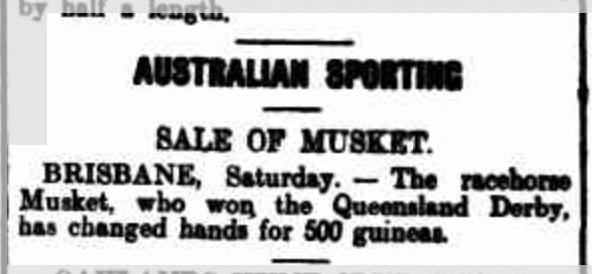
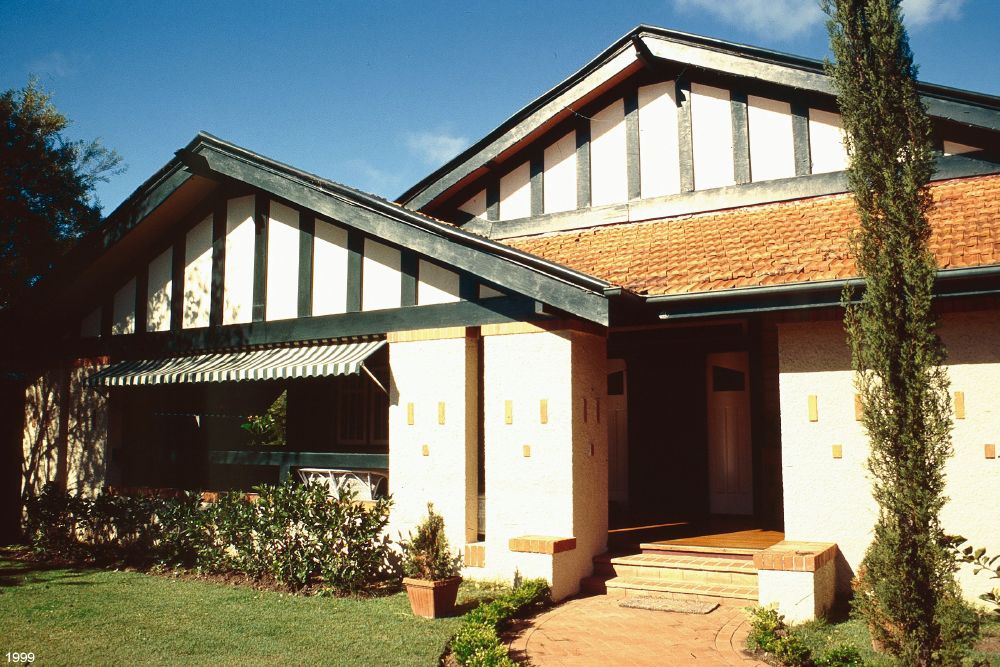
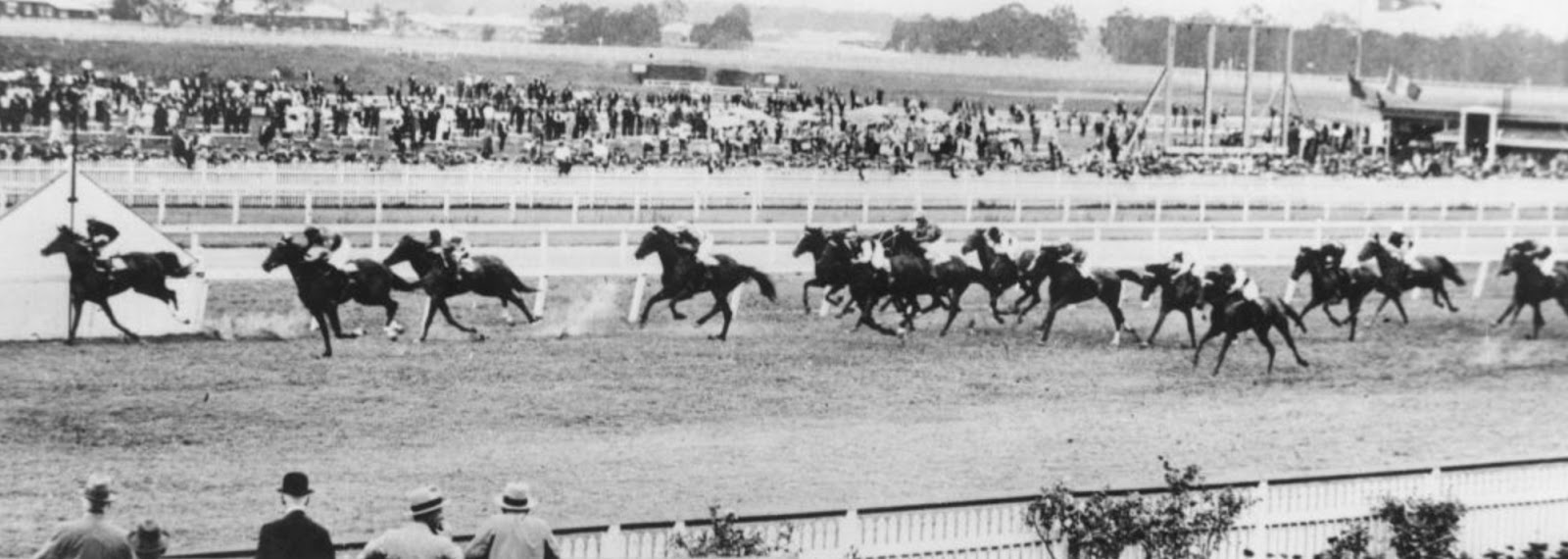
Musket Villa, along Lancaster Rd in Ascot, was built for horse trainer and rider William “Billy” Booth in 1923. He named his house after Musket, the horse he trained and rode to win the Queensland Turf Club Derby in 1900.
The single-storey, stucco interwar bungalow has been recognised as a heritage house for its architectural significance as it was designed by Brisbane’s prominent architects, Thomas Ramsay Hall, and George Gray Prentice.
Hall & Prentice also designed Brisbane City Hall and the Sandgate Town Hall. Mr Booth knew Mr Hall as both were involved in racing through the Queensland Turf clubs.
The house is also cited for its social significance. Musket Villa had purpose-built stables and training establishment, aside from being Mr Booth’s residence. The property is well known to the Brisbane racing community.
Who was Billy Booth?
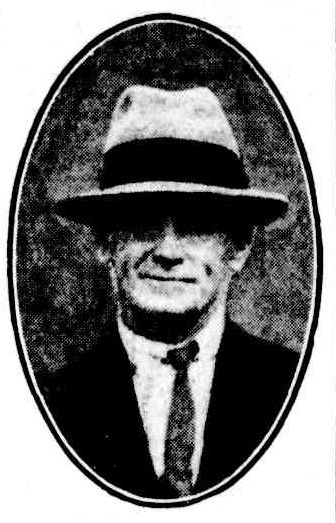
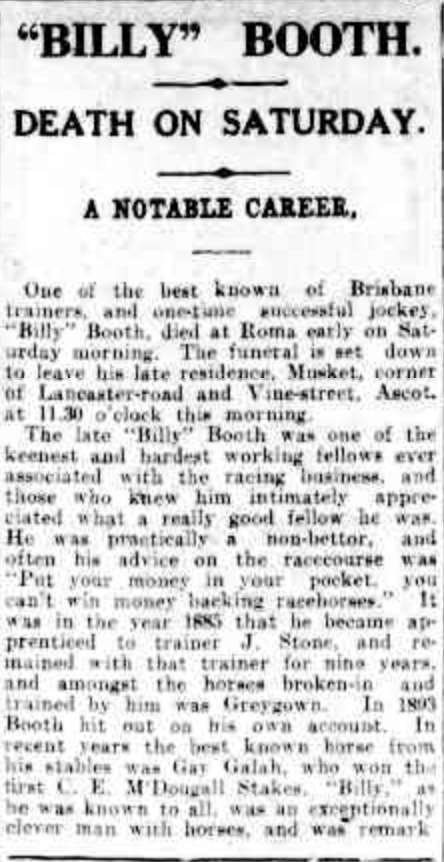
Billy Booth began as an apprentice to horse trainer John Stone in 1885 and worked with some prize-winning horses, such as Grey Gown and Dundonald, to take on the Brisbane Cup and the Moreton Handicap.
Photo Credit: National Library of Australia
By 1893, Mr Booth had opened his own training stables and had over 21 horses in his ward. Some of these horses succeeded in the Stradbroke Handicap and won ribbons at the Brisbane Show.
In 1899, Mr Booth, riding Musket, went on to win the Queensland Derby the following year. However, shortly after their success, Mr Booth met Lucy Adelaide and decided to retire from riding. He sold the horse in 1901 but continued to work as a horse trainer.
Photo Credit: National Library of Australia
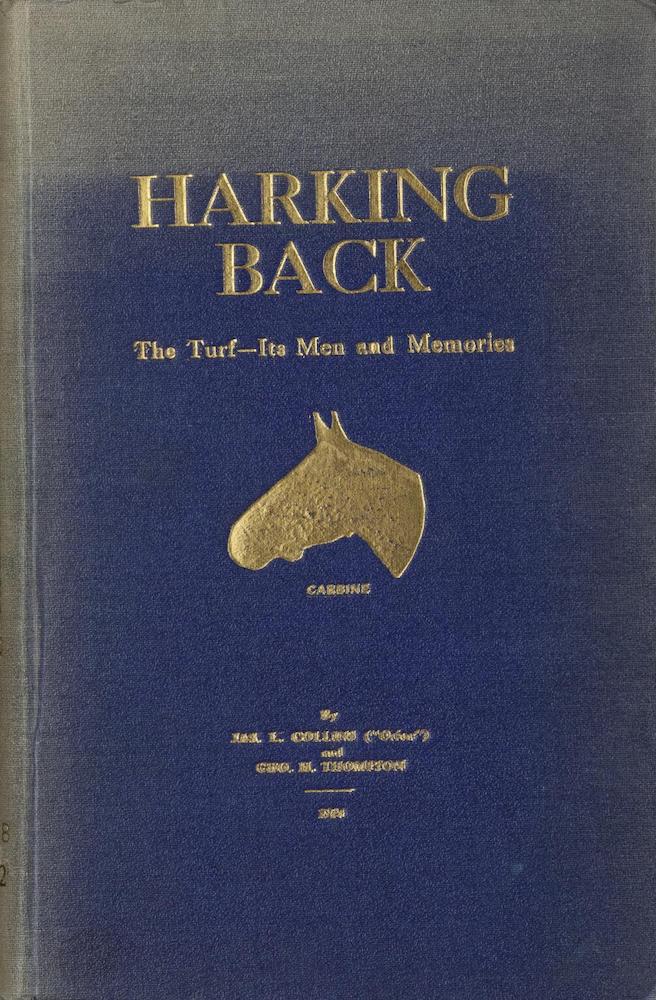
In 1922, the Booths decided to buy land in Ascot, at the location where their villa remains standing until today. Mr Booth wanted his property to include up-to-date horse stables that will provide comfort for his workers and equine charges. The property was quite well-designed and was featured on the pages of the publication “Harking Back – the Turf, Its Men and Memories” from James L. Collins.
The publication described Musket Villa as a “red-tiled home with its beautiful gardens and lawns [and] every modern appointment and equipment.” Mr Collins also credits Lucy for her taste in furnishing their residence.
Photo Credit: National Library of Australia
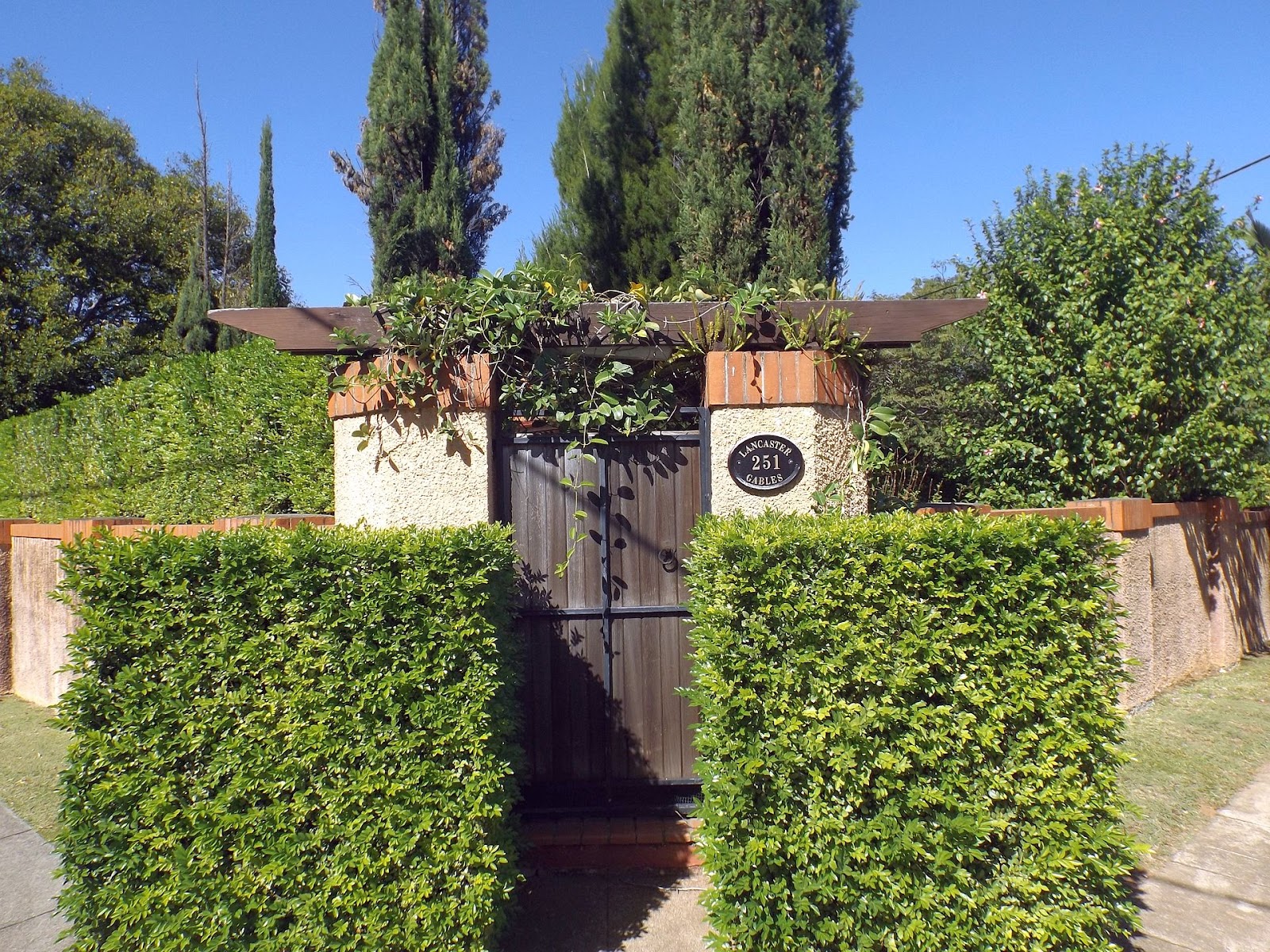
Musket Villa to Lancaster Gables
After Mr Booth’s death in 1927, Musket Villa was leased by horse trainer WJ Shean until 1941. Lucy Booth was still a resident of the villa when it was converted into four flats. When she passed away, the property was left to her son, Norman Booth, who lived there until his death in 1955.
Photo Credit: National Library of Australia
With the Booths gone, the house was turned into Lancaster Gables, a lowkey Bed and Breakfast. The garage at the back was demolished to accommodate more dwellings.
Most of the villa’s original features have been retained throughout the residence, including its ebonised timber detailing, timber panelling in the entry, leadlight doors, and built-in leadlight display cabinets in the living and dining rooms. However, new fittings were installed in the bathrooms and kitchens, and many of the rooms have air conditioning.
To many people, Lancaster Gables will always be called Musket Villa, as Billy Booth originally intended, a prized home named after a prized horse by a man who took pride in Ascot’s rich equine historical connection.
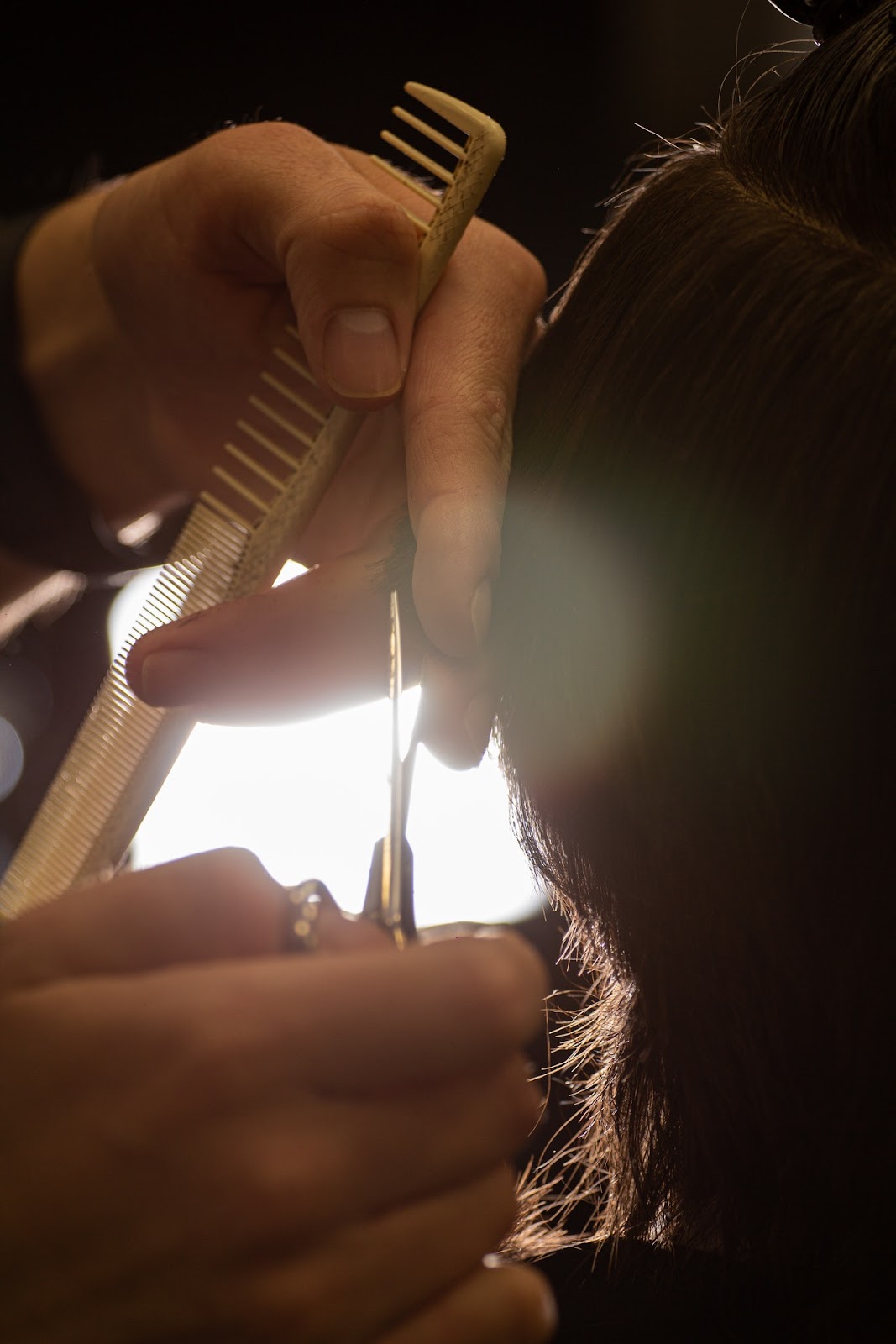
After almost half a century of cutting hair, Ascot barber Phil Tharenou is getting ready to hang up the clippers at his eponymously named Phil’s Barber Shop on Kent St, but his reason for contemplating closure has nothing to do with how well his business is doing.
The building where Mr Tharenou’s barber shop is located was sold in 2021. Sadly, this means his beloved barber shop will eventually be demolished to make way for new development. However, Mr Tharenou plans to operate Phil’s Barber Shop in the same space while he still can, even as he is preparing for its inevitable closure.
Simple Beginnings
Mr Tharenou, an Australian-born Greek, had an early start in his line of business, when he got an apprenticeship when he was 15.
He did not have money to set up his own business after he learned the ropes, so a mate helped him financially. He was married 10 days before opening his own shop in 1975.
His business became a success and he was able to pay back his friend in full in just a year.
Photo by RODNAE Productions/Pexels
The Ascot barber shop thrived through good ol’ fashioned word of mouth, referrals, and repeat business. People just kept coming back. Despite having no internet bookings and even though Mr Tharenou remodelled the place only twice, people still sought his shop out. Customers would only walk-in to get their barbering needs or call the shop’s landline.
Phil’s Barber Shop has cut the hair of some notable personalities. Some of his former clients included award-winning ad guru John Singleton and late politician Don Lane.
Photo credit: Matheus Wladeka/Pexels
“Been a customer for more than 20yrs. Phil a great advertisement for his own business. Always remembers his customers and a wide range of conversation topics. Very competitive price and quick service,” shared local Jeffrey in a review for the barber shop.
“Now everyone has a problem as Phil is going to retire soon,” Rod, one of the shop’s patrons quipped.
Although Phil’s Barber Shop is closing its doors in late June 2022, Mr Tharenou’s patrons can still find him at West End, where he will continue to trim for a few regulars at a friend’s barber shop.
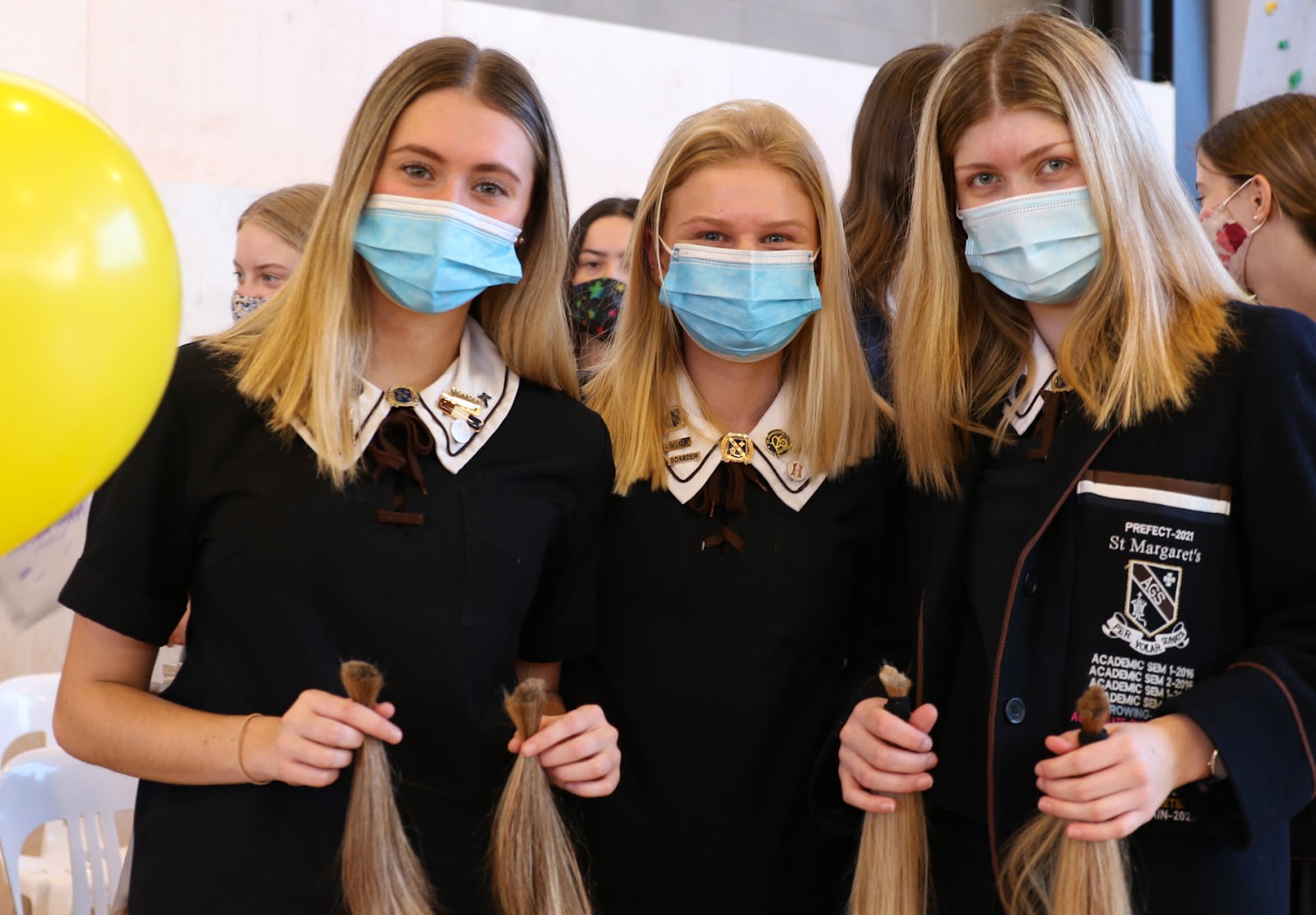
Did you know that the Ponytail Project, an annual fundraising initiative from Cancer Council Queensland, started at St Margaret’s Anglican Girls School in Ascot? This year’s campaign has students rocking the chop yet again, aiming to attract over 30,000 ponytails and $850,000 in donations.
The movement was inspired by a parent from the St Margaret’s Anglican Girls School community who was battling breast cancer. Four students, Beth Flint, Meg Fraser, Maria Cobain, and Annabelle Crossley, first stepped up and the Ponytail Project was born.
Every year since then, the girls at St Margaret’s would mount the campaign. In 2018, Cancer Council Queensland helped in launching the initiative throughout the region. The following year, the movement spread to South Australia and Western Australia.
Since the campaign started in 2015, the Ponytail Project has raised more than $1.655 million.
Photo Credit: StMargaretsAGS/Facebook
What Happens to the Ponytails?
Donated ponytails are turned into wigs that will go to people suffering from hair loss as a result of their cancer treatments or medical condition. The hair donations are sorted and graded by hair type, length and colour at participating Sustainable Salons depots. It takes about 20 to 25 ponytails of the same type and quality to create one wig.
After sorting, the ponytails are then sent to charitable organisations and wigmakers who directly work with groups, hospitals, and local institutions. Other ponytail donations may go into research projects to create sustainable wigs.
The event also matches monetary donations to fund the projects of Cancer Council Queensland. The council cites October as the official month for the campaign but it can be done at whatever time is convenient for the students.
Students may assemble in groups or as an individual and then create their own campaign via the council’s online facilities for sharing on social media or tracking the progress of the fundraiser.
Cancer Council Queensland CEO Chris McMillan said that they witnessed more students participating in the Ponytail Project year after year. He encourages more kids to make a difference in other people’s lives by joining the cause and spreading the word.
Ascot has long been regarded as one of the best places to live in Brisbane, with its affluent neighbourhood and property values maintaining their strong growth. Take a look at its evolution into the blue-chip suburb that it is today.
With a tightly held collection of desirable and beautiful houses, Ascot is known for its picturesque tree-lined streets, hilly residential areas with lovely views of Brisbane, racecourses, and upmarket lifestyle precinct.
Early Ascot
Historically, Ascot was occupied by the Aboriginal Turrbal group, described by explorer John Oxley as “the strongest and best-made muscular men I have seen in any country.”
The Turrbals built hunting grounds near the Brisbane River and established private ownership of specific sections of the area.
Wealthy settlers started moving into Ascot in the mid-1800s, following the clearing of lands and building of basic roads. Pastoralist James Sutherland bought a large portion of land in the area, which was later established as Sutherland Avenue, one of the highly sought-after locations in the suburb.
This section consists of 15 magnificent houses, including the heritage-listed house, Windmere. The Victorian-style house with its iron-lace verandahs is one of the finest examples of Queensland’s colonial architecture.
In the 1860s, the Eagle Farm Racecourse was established in Ascot in support of horse racing, one of the earliest sports in Brisbane. Up until the 1920s, racing stables were a frequent sight around the suburb.
Photo Credit: State Library of QueenslandPhoto Credit: State Library of Queensland
The Doomben Racecourse opened several years later in the 1930s and, like the Eagle Farm Racecourse, became a prominent racecourse in South East Queensland and was well-attended by the region’s most affluent families.
Photo Credit: State Library of Queensland
Doomben was originally a property of The Crown until 1915, when it was bought and turned into a sustainable racing track.
Photo Credit: State Library of Queensland
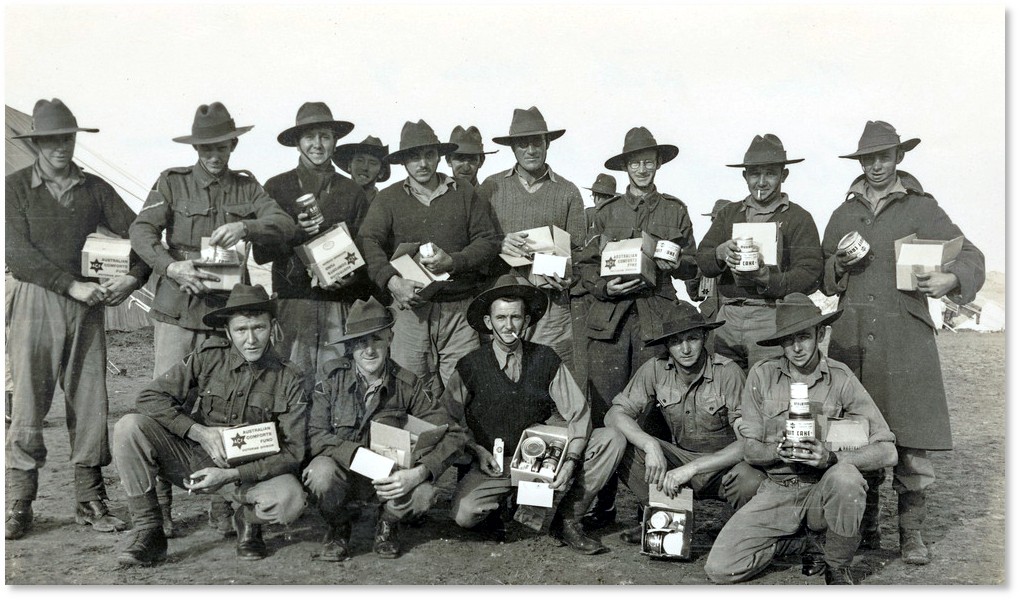
During World War II, the racecourses were primarily converted into Camp Ascot for the Allied troops. Several buildings and homes in the suburbs were also occupied by the U.S. forces, including the Ascot spy house, Nyrambla, where the Central Bureau intercepted and decoded Japanese transmissions.
Today, the Brisbane Racing Club, formed in 2009, manages the racecourses and preserves the history of thoroughbred horse racing in Queensland.
Urban Growth in Ascot
The establishment of both racecourses spurred the growth of Ascot with the opening of railways and tram services that fostered the development of the residential areas, schools, and shopping strips.
Photo Credit: State Library of Queensland
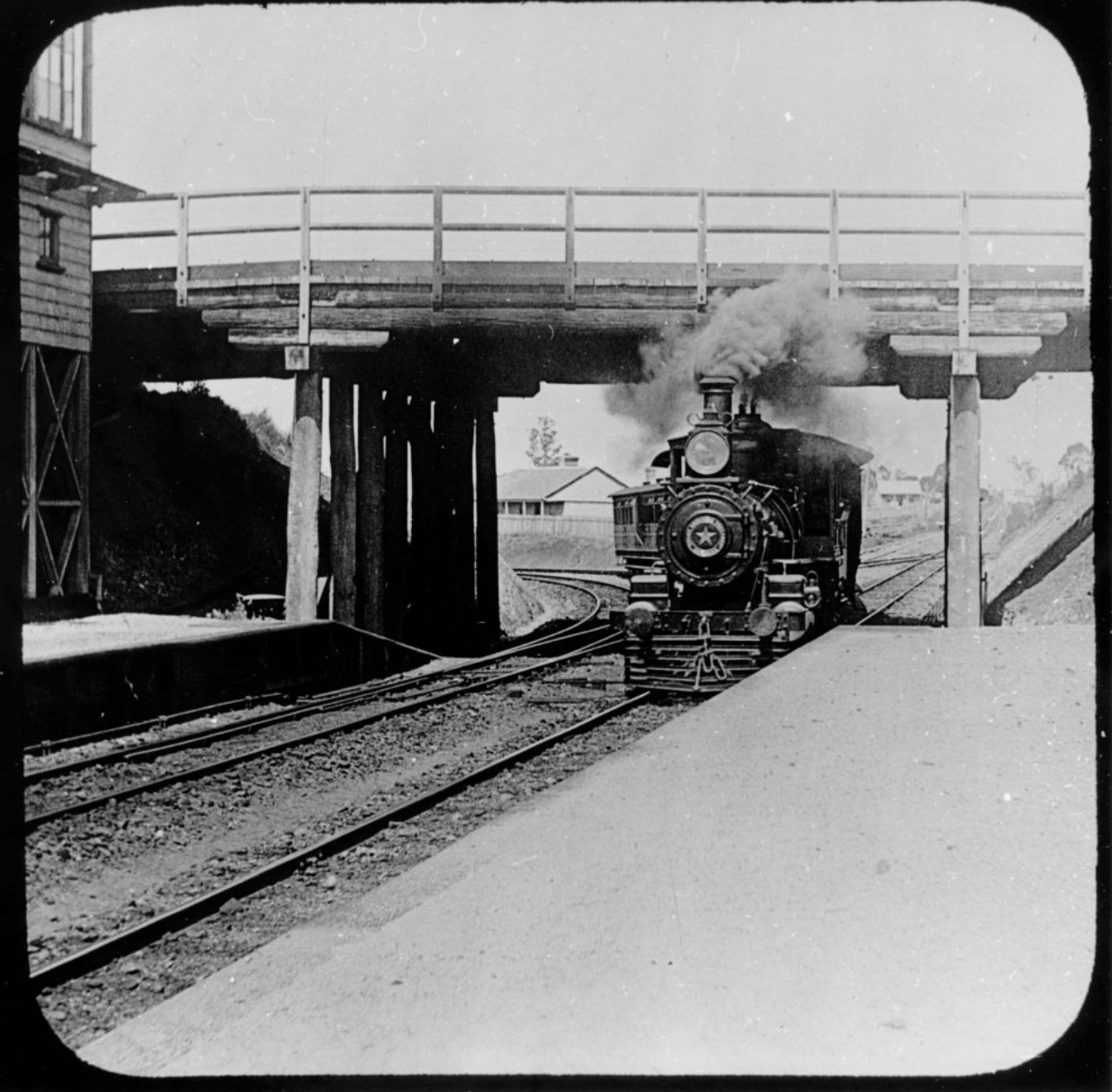
The Ascot Railway, built in the late 1880s, provided convenience for punters and racing aficionados who used to arrive via horse and buggy, shuttlecock boat, or cross river.
After World War I, the Ascot Railway Station was expanded with a second larger building and a pedestrian subway. It was electrified in the 1980s. Today, most of its antiquated features remain but it has been unstaffed and suspended since 1993.
Photo Credit: State Library of Queensland
The Ascot State School opened in the 1920s on Pringle Street, following the dramatic reforms made in the Queensland Education system. Six years prior, Ascot locals determined a need to establish a state school but World War I disrupted its construction until 1919.
When it finally opened, Ascot State School had an initial batch of 124 students, who were not just taught academics but also developed their aesthetic tastes, gardening skills, and sports abilities.
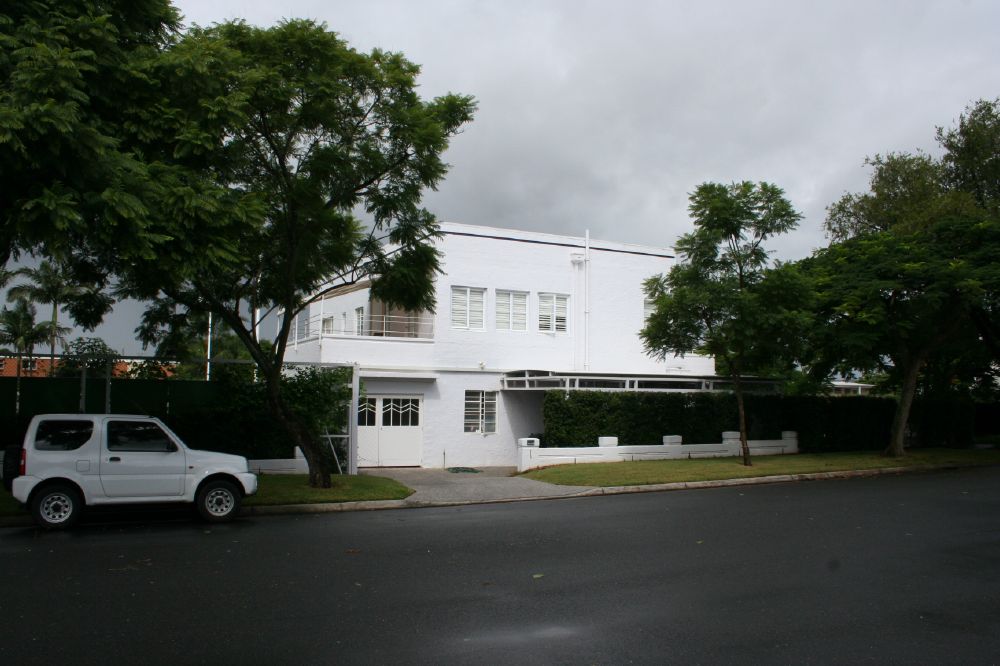
One of the significant homes to be built during Ascot’s astounding urban growth was Chateau Nous along Rupert Trc, which served as an early example of Functionalist domestic architecture in Brisbane.
Photo Credit: Queensland Heritage Listing
The house was built for Brisbane dentist George Stewart and his wife Eileen and was considered as ultra-modern during its time as it featured an electric dumb waiter and a line of electric kitchen appliances.
Photo Credit: Brisbane City Library
Today, Racecourse Road has become the prime location for the village shops and restaurants that also serve Hamilton locals. It boasts of over 130 businesses.
The tram that once ran down the centre of the street stopped service in the 1960s. Today, Ascot is serviced by four transport stops and TransLink’s CityCat terminal in Bretts Wharf.
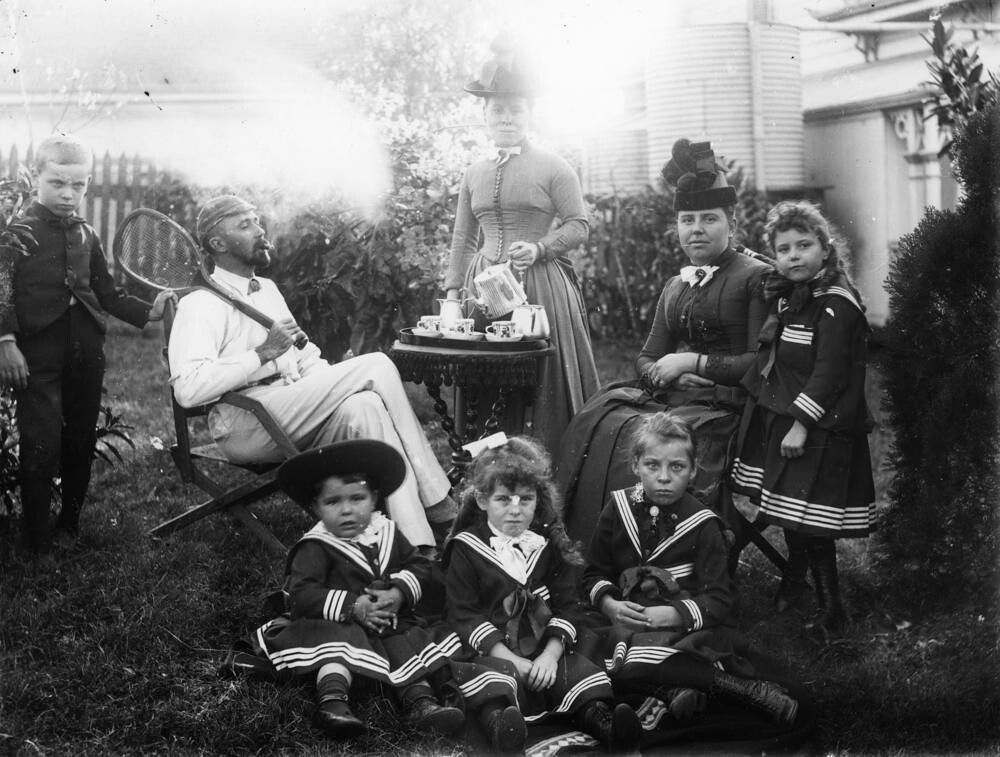
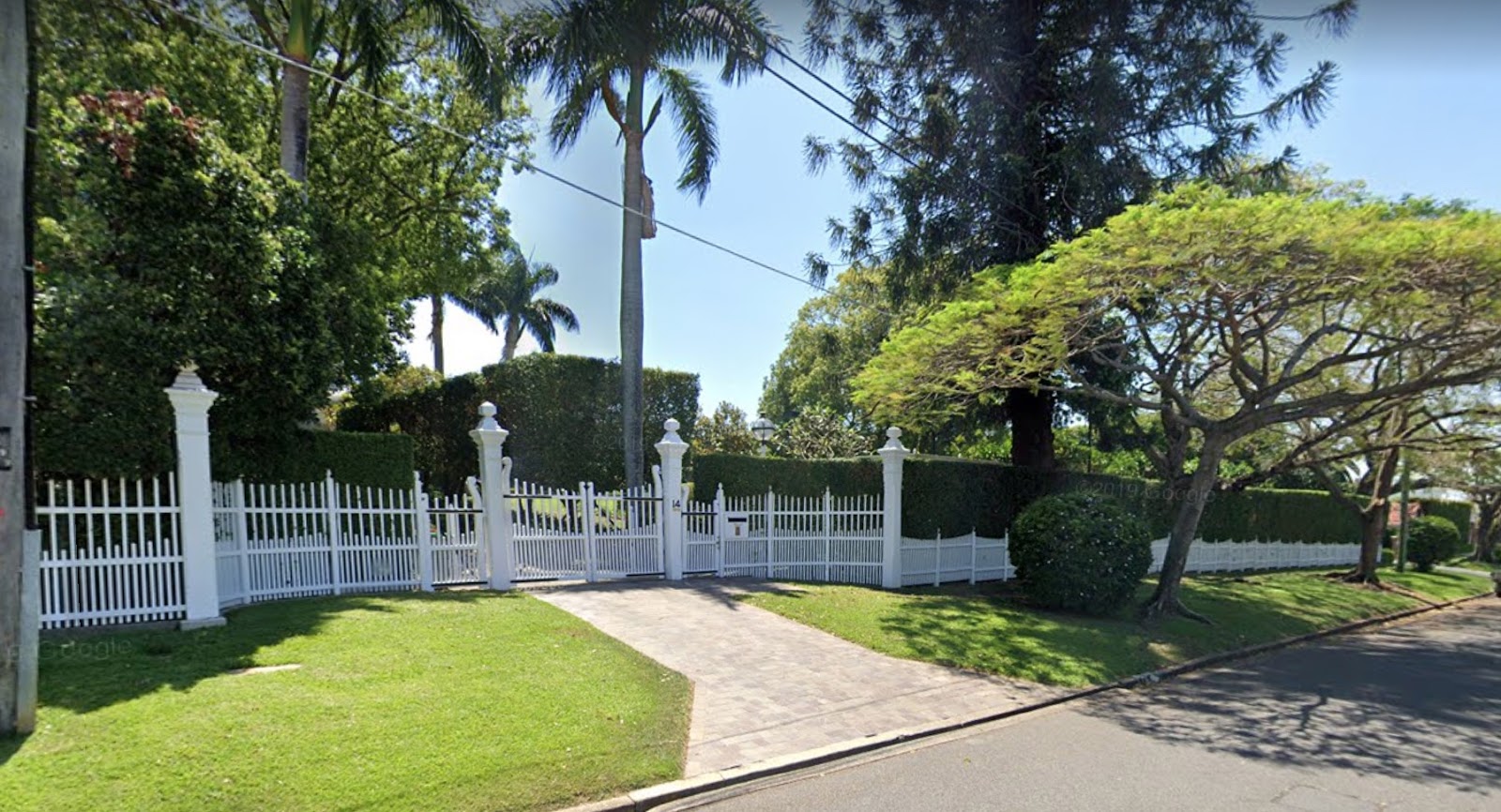
Windermere is one of Australia’s most beautiful heritage homes. Built in the 19th century by Ruth Sutherland and her husband, it is one of only 15 beautiful, blue-chip homes on the eponymously named Sutherland Avenue in Ascot.
Windermere was built for solicitor John George Appel and his wife, Ruth Sutherland in 1886. Ms Sutherland was the daughter of pastoralist James Sutherland who owned many acres of land in the city.
During their marriage, Mr Appel worked as a solicitor for 10 years before he became a pastoralist and then eventually joined politics as a member of the Hamilton Shire council from 1890 to 1908. Mr Appel also became the mayor of the municipality two times.
Windermere’s Distinct Features
Windermere was built as a single-storey chamfer board home with corrugated iron roofs. The house is set at the back of the Sutherland Ave lot, looking over to the gardens, the tennis court, and its mature trees.
It is believed that Windermere was not the original property on the land and that the Sutherland patriarch had the first house demolished so he could give this beautiful home to his daughter.
Richard Gailey was touted as the architect and designer of the house. Its wide verandahs and large, symmetrical bay windows have been kept intact through the years.
The entire property is 4,700 square metres. Currently, is a six-bedroom four-bath home with a secure, triple-car garage, a professional-grade kitchen, two courtyards, and a guest wing with its own kitchen.
Located in one of the most prominent locations in Brisbane, it’s not surprising that the list of Windermere’s previous occupants read like a Who’s Who of Brisbane society.
When the family moved to Nerang, Mr Appel pursued farming whilst still working as a public servant. Windermere was turned over for renting by Charles Frederick White until 1918.
By 1923, George Kermode Jeffrey had bought the property, remodelled the eastern verandah, and demolished the kitchen and servants’ quarters.
After the Jeffreys, Windmere became the property of Dr Ellis Murphy, who was originally from Randwick in NSW and moved to Brisbane in the 1920s. The doctor worked at Mater Public Hospital, Brisbane General Hospital, the Greenslopes Repatriation Hospital, and the Kenmore Sanatorium. He was also a part-time professor at the University of Queensland.
The Murphys became the longest residents of Windemere to date, calling this beautiful house their home from 1928 to 1967. Dr Murphy was knighted for his service in medicine in the 1960s.
Photo Credit: Google Maps
After the Murphys, Barbara and Trevor Cottee lived in the property until 1984, when it was bought by Robert Geoffrey Bentley. Two years later, Peter Maloney would buy the house and conduct substantial modifications and home improvements, including the addition of a new bathroom and study on the north side and the removal of the bathroom and laundry at the back of the house.
Photo Credit: Google Maps
The years between the 1990s and 2014 saw Windmere change hands a number of times. Chris Miers bought the house from pub baron Andrew Griffiths in 2014 for $10.2 million, a record-breaker for Brisbane at the time. The Miers family has since moved to Teneriffe.
In spectacular fashion, Windermere’s most recent changing of hands was in 2020, when its sale fetched another suburb record of $13 million after just three weeks on market.
Living in Sutherland Ave, Ascot
Sutherland Ave is a tightly-held market with 15 beautiful homes. More than half of the owner-occupiers of this street have lived in their impeccably kept houses for an average of 11 years. Only a quarter of homeowners in Sutherland Ave have stayed there for less than three years.
Other houses on this street are owned by an award-winning fashion designer, a real estate mogul, and an aviation CEO. Sutherland Ave’s other drawcard is its proximity to Ascot State School.
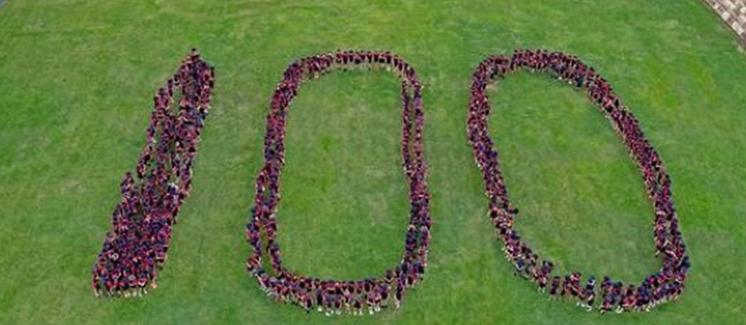
Ascot State School, which turned 100 in 2020, is celebrating its centenary belatedly in May 2022 due to the pandemic. The school has earned a well-deserved reputation for offering high-quality education for young minds. Know more about how the school has evolved over the past hundred years.
Early Beginnings : Block A
Ascot State School stands in the land that was traditionally occupied by the Turrbal and Jagera people in the late 1850s, which was subdivided after the opening of railways to the Eagle Farm Racecourse in 1882. Housing and community developments, however, took place after the turn of the century when the electrified tram to the racecourse opened along Kingsford Smith Drive and Racecourse Road.
By 1909, the Queensland Education system was established and compulsory school attendance was enforced. As the student numbers increased, plans were set in place for a state school in Ascot.
In May 1914, a section of Pringle, Anthony and Mayfield streets was purchased for the state school and a public meeting took place to solidify the intention. Coming up with the funds to build the school, however, fell short due to World War I.
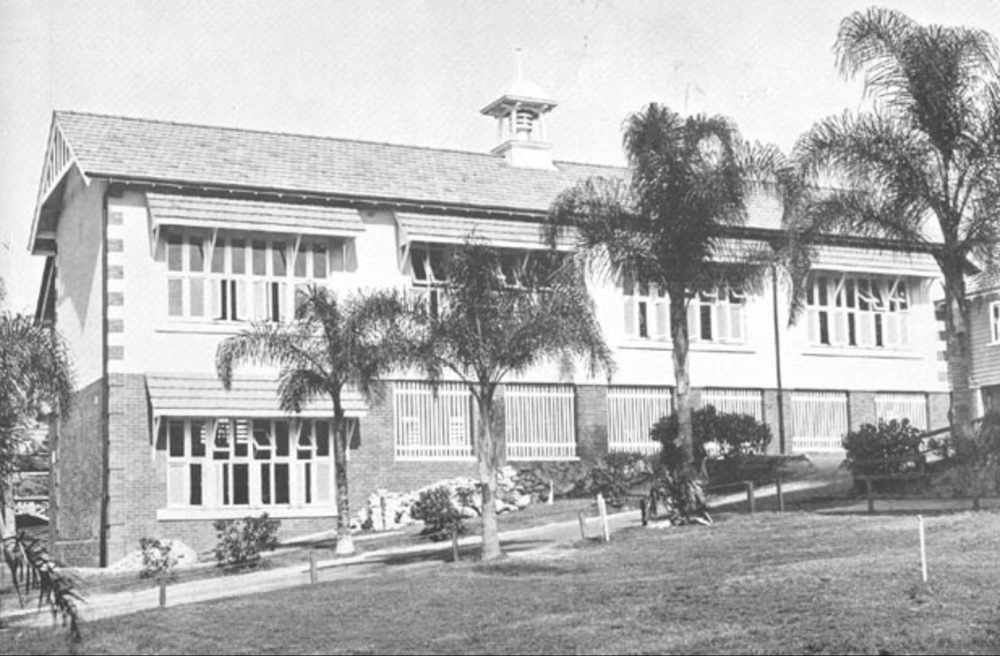
The approval for Ascot State School was granted in June 1919 and the following year, in May 1920, the school opened with 124 students. This building, which is still existing as Block A, was an attractive brick building with three classrooms with large windows for natural lighting, a verandah, and a teachers’ room.
Photo Credit: National Library of Australia
A Beautiful Learning Environment
From the very start, Ascot State School was envisioned as a beautiful learning environment for the kids with its strict tree-planting program for colourful flowering trees like Jaracandas and Poincianas. It had an extensive school ground designed for play-based education, outdoor activities, and sports.
Thomas Henderson, the first headteacher, who stayed with the community for 20 years, believed that a beautiful school will inspire better learning. He also appreciated the value of libraries and arranged to have a library and reading room for Ascot State School. He hired an art specialist for the school’s ambitious arts and crafts program.
Photo Credit: National Library of Australia
Mr Henderson also thought of having mural paintings on classroom walls for educational purposes in the 1930s. Some of these included murals depicting the different agricultural, transport, and tourism industries of Queensland. There were no other murals of this kind in the region.
Meanwhile, the students were trained to learn gardening, which developed their aesthetic taste and improved their discipline. The kids also had access to an impressive array of playground equipment, a tennis court, and a swimming pool.
Photo Credit: National Library of Australia
Ascot State School followed the colonial curriculum, where kids are taught to read, write and learn arithmetic. Grammar, history, geography, needlework, and mechanics were subsequently introduced in the upper levels.
Community Engagement
By 1921, enrolment at Ascot State School doubled to 310 students thus additional funding from the government provided for the construction of the north wing, which is currently Block C. Here, additional play space and a gymnasium were incorporated along with more classrooms and a teachers’ room. The building was finished by 1923.
In 1927, Ascot State School had 568 students thus another plan to expand the site was underway. The addition of the southern block, now known as Block B, turned the school buildings into a U-shaped complex. This block with more classrooms for 200 kids officially opened in 1928.
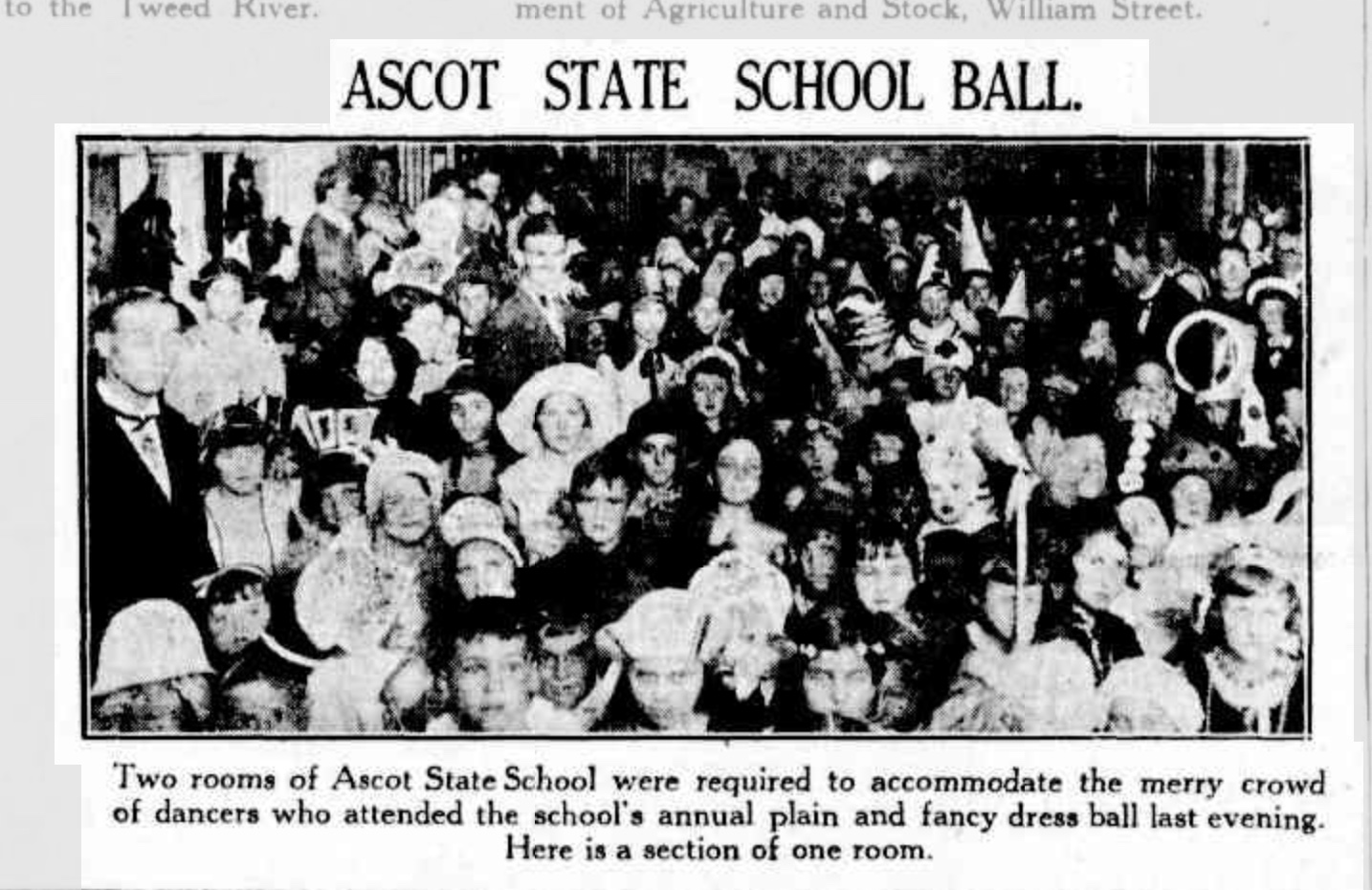
In the 1920s, the Ascot Show Society had its annual event at the Ascot State School grounds. Fancy balls, fundraisers, walkathons, and various community events were also held in the suburb with the state school as the popular venue.
Photo Credit: National Library of Australia
Photo Credit: National Library of Australia
Impacts of the WWII
Funding stalled during the Great Depression in 1929, delaying the expansion of Ascot State School despite the increasing school population until 1932, with the extension of Block C with two more classrooms and lavatory facilities. Block B also had new lavatory facilities and a dress shed for the swimming pool. Between 1933 to 1939, further extensions were made to Ascot State School with three-storey buildings and ground enhancements, as well as a new tennis court to replace the old one.
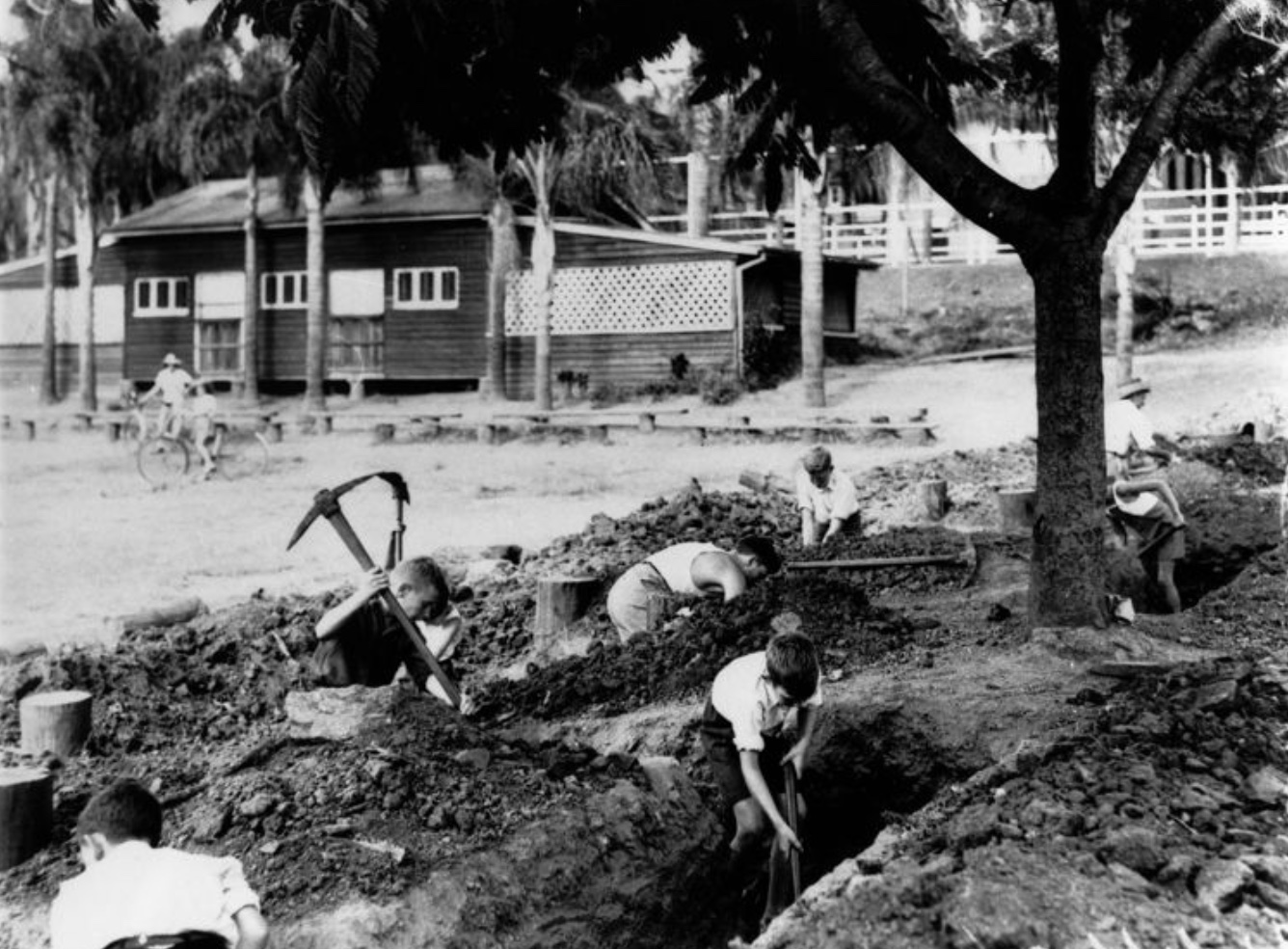
During World War II, the Queensland Government made school attendance optional. Slit trenches were dug on the ground in case of Japanese air raids. The students and staff also focused on growing produce and flowers to supply hospitals and the Red Cross canteens. They also organised fundraising events for Australian soldiers.
Photo Credit: State Library of Queensland
After the war, Brisbane’s population swelled, demanding more state education support. In response, new buildings were added to Ascot State School from the 1950s to the 1960s. In 1955, extensive drainage work was undertaken at the school grounds, leading to the upgrade of the Meibush Oval.
From the 1970s to the 1980s, several alterations were undertaken for Blocks A, B and C to address the growing student numbers. The pool was also enlarged, while landscaping was enhanced.
Ascot State School Today
Ascot State School has maintained its ranking as one of the best schools in Brisbane. From 120 students in 1920, the school has maintained a maximum enrolment capacity of 807 students per year.
The school also takes pride in the performance of its students in literacy and numeracy. In the National Assessment Program Literacy and Numeracy (NAPLAN), the school has a high percentage of students in the upper two bands in NAPLAN reading, with 87% in Year 3 in 2018.
The Ascot school community was supposed to celebrate its centennial in May 2020 but due to the pandemic restrictions, the celebratory affair has been moved to May 2022.
Photo Credit: Ascot State School
Ascot State School has produced notable students like Nick Earls, author, Stephanie Rice, Olympic swimmer, Daniel Graham, film director, Henry George Fryberg, judge of the Supreme Court of Queensland, Adam Winning, radiologist, and musicians Grace Shaw and Avra Velis.